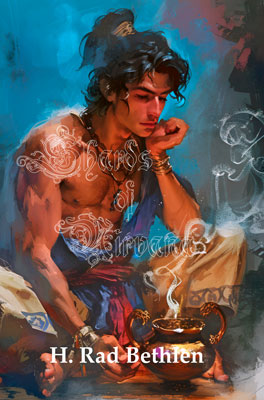
Shards of Nirvana
A man on a spiritual journey must uncover his past, confront his nemesis, right a wrong, and free his friends from an unjust punishment, in order to achieve inner peace.
Parallax was trained by his father for a position in the royal court but he's never wanted it. As his father lies on his deathbed he makes his son promise to visit the emperor. This begins a journey whose end is uncertain.
What Parallax wants is to achieve moksha, to escape from the cycle of rebirth. He feels it is his fate to reject court life, to reject comfort, wealth, and prestige and go into the forest. There, alone, he will purge himself of the chaos and confusion within. Yet the sins of the past are not so easily purged.
Ravik, once Parallax's teacher, has become a powerful, evil spirit, a rakshasa. He has achieved all he has desired. His rewards have been great--the cost greater. Yet all can be taken away by those he serves, those whose power is akin to that of the gods.
Parallax and Ravik, their fates are intertwined. They are destined to confront one another in order to decide not only their fates but those of many others. Guilt and innocence, justice and injustice, love and hate, enlightenment and escape or another turn of the great wheel of life--all this and more must be decided.
In Shards of Nirvana, the award-winning fantasy author H. Rad Bethlen marries western storytelling with eastern mythology. Here the gods and spirits of Hinduism are shown as they are no where else. No story like this has been written since William Buck retold the ancient, epic poems Mahabharata and Ramayana in a novelized form.
Buy Shards of Nirvana - Kindle on Amazon
Buy Shards of Nirvana - Paperback on Amazon
Buy Shards of Nirvana - Hardback on Amazon
To read the first three chapters click here
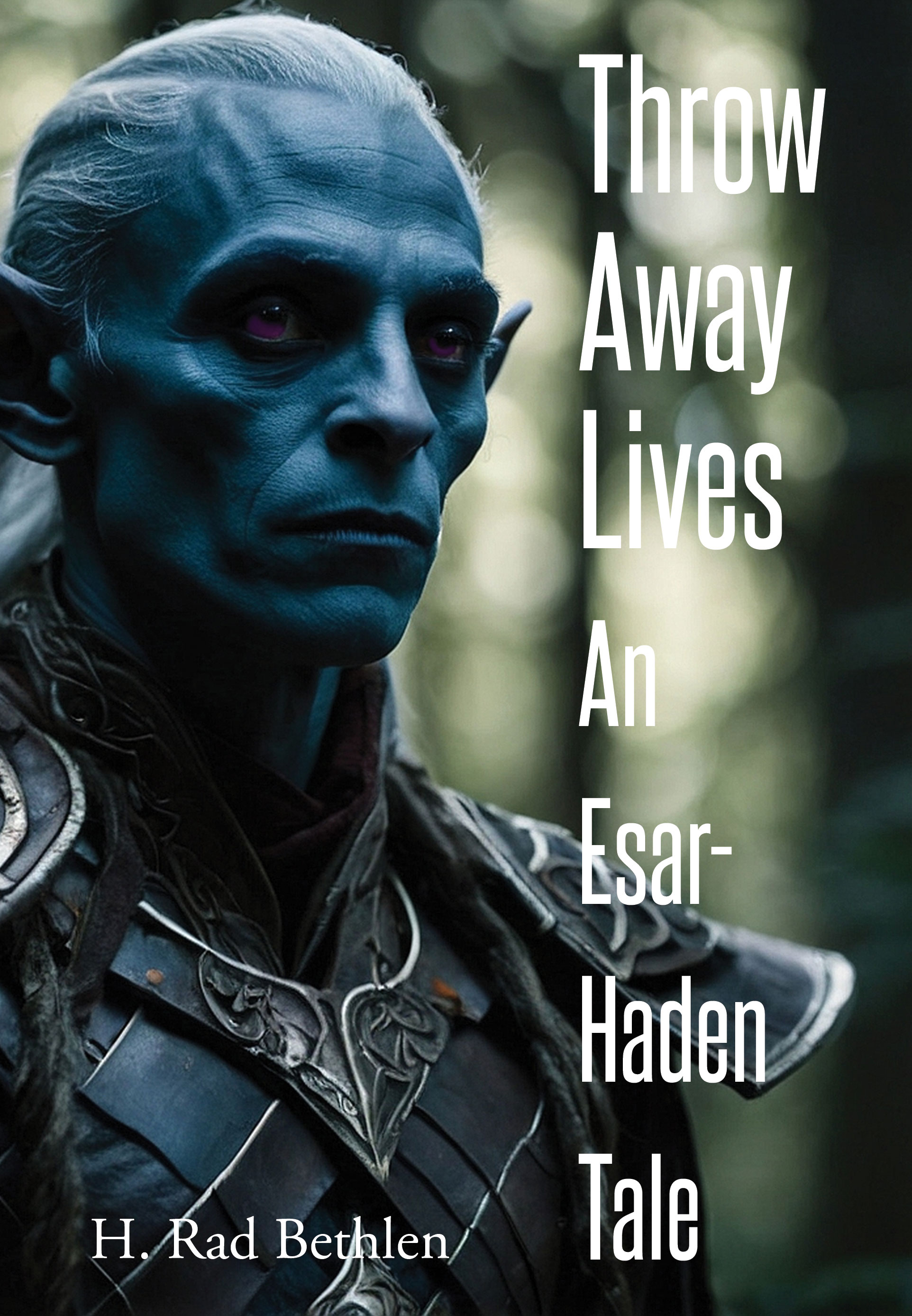
Throw Away Lives
Esar-Haden, the lovable dark elf thief and assassin, rots in a dank dungeon--awaiting the executioner's axe. Meanwhile, unbeknownst to him, an order of knights searches.
One of the knights, Sir Gilroy, finds Esar-Haden and frees him--much to the dark elf's surprise. What's this all about, wonders Esar-Haden. What he doesn't know, but is soon to find out, is that he plays a part in a prophecy.
Artain Geddes, high wizard in service to the King, grows old and frail. Magic has extended his life past what nature allotted. He wants more. Patience, he reminds himself, as a long-unfolding plan is coming to fruition.
Brother Chulainn Callan knows he hasn't long to live, despite his health and youth. He's seen his death at the hands of a dark elf. He must find him, not to stop the heinous act--to ensure it happens.
Keir D'Arcy hasn't long to live, either. He knows it and is fighting like hell to save himself. He will go to any length to preserve what is most precious to him.
Don't miss this, the most exciting and dramatic Esar-Haden adventure yet!
Buy Throw Away Lives - Kindle on Amazon
Buy Throw Away Lives - Paperback on Amazon
To read the first chapter click here
The Working Artist
How to be Successful, Happy, and Financially Secure as an Artist
They'll tell you it's impossible.
They'll tell you to get a real job and create in your spare time.
They'll beg you not to do it--not to become a "starving artist." You'll live miserable and die poor.
They think they know but they're wrong.
In this straightforward, easy to understand, easy to implement financial guide H. Rad Bethlen will show you how to become a working artist.
This isn't a book on theory. Nor is it a collection of coupon-clipping, money-saving tips. It's a lifestyle guide written by one who lives the life.
If you want the act of creation to be a long-term proposition you need a firm financial foundation. This book will show you how to build it. In this one-of-a-kind guide H. Rad Bethlen shares everything he's learned from a decade as a working artist. Whether you are a starving artist struggling to afford your art or a dreamer at the beginning of your artistic journey you need this book.
You don't just want to survive, you want to thrive.
This book will show you how.
Buy The Working Artist-Kindle on Amazon
Buy The Working Artist-Paperback on Amazon
Buy The Working Artist-Hardback on Amazon
To read the Introduction click here

Storytelling, the Art and Craft of Great Fiction
It seems so innocent. We love stories and want to tell our own. Then we get started and nothing goes as planned. It's hard when we thought it would be easy. It's a confusing jumble on the page when it made perfect sense in our head. It lacks something but we don't know what.
The blank page is cruel terrain--at first. In time it reveals its secrets, but only to those who persevere. That takes sacrifice and discipline. There's no easy path, no short cut to success. The truth of an art cannot be tricked into revealing itself. But there are those who know.
In this book, H. Rad Bethlen, the award-winning author of The Working Artist, Parallax, and many other works, shares everything he knows about the art and craft of telling great stories.
This book is organized into three sections: how to develop a story, how to write a story, and how to edit a story. If you have no experience at all this book will show you the way. If you have been writing for years but have reached a plateau this book will elevate you. Even if you're not a writer but tell stories in some other medium this book will improve your craft, will make your stories great.
Storytelling is about identifying and discussing the techniques used by humanity's greatest storytellers. It is a must read for anyone practicing the art and craft of storytelling.
Buy Storytelling-Kindle on Amazon
Buy Storytelling-Paperback on Amazon
Buy Storytelling-Hardback on Amazon
To read the Introduction click here

Teens Telling Stories
In this unique guide for teen writers H. Rad Bethlen encourages and instructs. Unlike other books on the craft of fiction, this book approaches from a practical, real-world angle. Abstract theory is jettisoned and in its place is realistic, understandable advice. H. Rad Bethlen starts where the teen writer is at and guides them to a finished story they can be proud of. This concise guide will get any teen writer up and running, no matter where they start from. Full of encouragement, this guide does not talk down to teens or attempt to be buddy-buddy or hip. It is one author talking to another, sharing what works.
Buy Teens Telling Stories - Kindle on Amazon
Buy Teens Telling Stories - Paperback on Amazon
Buy Teens Telling Stories - Hardback on Amazon
To read the Introduction click here
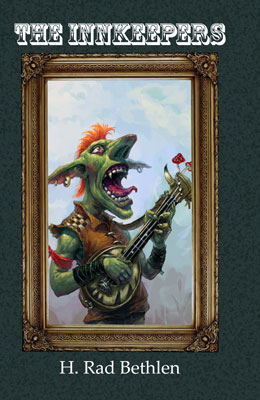
The Innkeepers
Eternal Rest: The term entrepreneur takes on a new meaning when the ruins of an ancient city are discovered by an enterprising innkeeper. He sets up shop and invites adventurers from far and wide. When he receives a lone patron desiring a night's peace he strikes a bargain that can't be undone. In this humorous tale a man asks himself what it takes to get a decent night's sleep.
A Voice so Pure: Tybalt, a half-elven bard and one of the innkeepers, recalls a shameful--but heartwarming--tale from his past. In it he sets out to win a singing contest by any means necessary, foul-play be damned. When a goblin arrives hilarity ensues. But when the goblin sings--
These and other stories await those who overhear the tall-tales of the innkeepers.
Buy The Innkeepers-Kindle on Amazon
Buy The Innkeepers-Paperback on Amazon
To read the first story click here

To Trick a God
Maret made a deal with a demon, a glabrezu named Velles, to be specific. She thought she'd gotten everything she wanted. She was called "Mistress," she was called "Queen." Now it's falling apart.
She fears death. She fears the eternal damnation she's earned. She begs Velles to help her. He can think of only way out of her predicament. However, she will have to pay a hefty price in a coin she has little off--her soul.
Abraxis, the demon lord of forbidden lore, has spent centuries assembling the scattered pages of the Book of the Damned. The book, written by an angel charged by the gods with cataloging their creation, is difficult to keep together--it has a will of its own. How long will Abraxis have to steal the eternal secrets from the immortal book before it flies apart?
Can Maret escape the punishment she's earned? Can Abraxis leverage his forbidden knowledge before it's too late? Can one trick an angel? Can one trick a god?
Buy To Trick a God - Kindle on Amazon
Buy To Trick a God - Paperback on Amazon
To read an excerpt click here
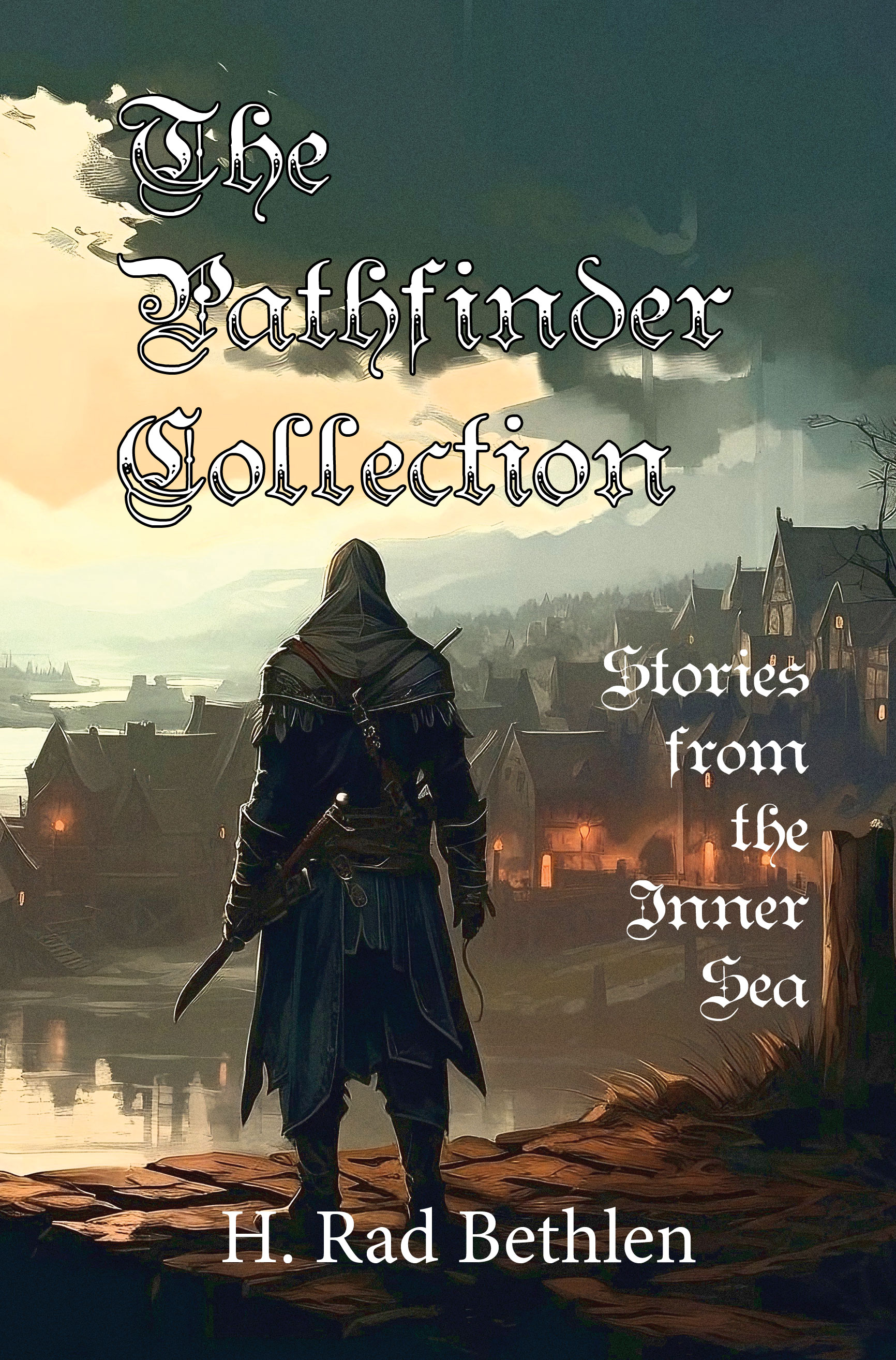
The Pathfinder Collection
In this collection of exciting stories the award-winning fantasy author H. Rad Bethlen brings to life the Inner Sea Region.
As H. Rad says in the introduction, "If you tell stories in the Inner Sea, if your characters roam there, may they meet Captain Brindisi or Old Khalden. It makes me smile to think they will." In this collection you will meet these memorable characters and many more.
Will Captain Brindisi, the sole survivor of the wrecked ship Dragon's Star, live to see another day? If so, at what price?
Will El-Barek, of godless Rahadoum, finally understand the true nature of love? Will he wish to?
Old Khalden, a member in good standing of the Brotherhood of Silence, takes an opportunity to school a pair of apprentice thieves, yet he himself has one final lesson to learn.
These stories and more await you in The Pathfinder Collection.
Buy The Pathfinder Collection - Kindle on Amazon
Buy The Pathfinder Collection - Paperback on Amazon
To read the first story click here

Horror Stories Set in Early America
Boone May - Murderer: A midnight ride results in a fantastic encounter. The once Union Army scout turned mine manager has enlisted the help of a hired gun, filling out his employment card with his last known occupation--murderer. But when the supernatural rises from the shadows to attack the two men, Boone May reveals his true self.
On the River Styx: A Jesuit priest starts down the Mississippi with a crew of explorers. Their intention is to find new nations to whom they will teach the Gospel. Their maps are blank, the river a mystery. When they come upon a skiff that is more rightly placed in the Book of Revelations than on the muddy waters of the Mississippi each man in Joliet's crew fears they've left one river for another.
These and other horror stories set in early America await the readers of this haunting collection of short stories by H. Rad Bethlen.
Buy Horror Stories Set in Early America-Kindle on Amazon
Buy Horror Stories Set in Early America-Paperback on Amazon
To read the first story click here
Horror Stories Set in Early America volume two
House of the Bull: Forced to leave the comforts of his abbey by a superior who despises him, Gonçalo, a Franciscan monk, follows a trail cut from the wilderness by a predecessor. He anticipates discomfort, for the wilds of California are not yet settled. He expects to find broken-down missions and religion abandoned. He is not prepared to find answers to questions he dare not ask. He is not prepared for the taste of blood.
Wife, Wolf, and Woodsman: Can a man be wed to a beast? What if he is and doesn't realize? What happens when a dauntless woodsman comes across a shapeshifter in the dead of night? Who will survive and who will die? Who will become a widow and who an orphan? Who will be wounded and who do the wounding?
These and other horror stories set in early America await the readers of the second volume of this haunting collection of short stories by H. Rad Bethlen.
Buy Horror Stories Set in Early America, Volume Two-Kindle on Amazon
Buy Horror Stories Set in Early America, Volume Two-Paperback on Amazon
To read the first story click here
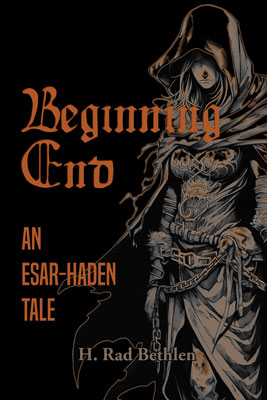
Beginning/End
Esar-Haden, a dark elf rogue, has it easy for once. He's the doorman at Poquelin's Cabaret, the most popular joint in the Ghetto of White Skin, the down-and-out section of Pwyll, one of many subterranean dark elf cities.
As usual, his luck doesn't hold. Esar-Haden is approached by what he takes to be the daughter of a powerful house. She says she knows everything about him. That worries him. She says she has a business proposition. That worries him more.
But business in Pwyll is never strictly business, there's always house politics to consider. Soon enough Esar-Haden learns too much. Not only does this put his life in danger but the life of his lover, Soléne.
Two houses are at war. Esar-Haden and Soléne are sucked into the maelstrom. Can there be peace between rival houses in a dark elf city? Does the only path to peace require Soléne's death? Is Esar-Haden virtuous enough to make the ultimate sacrifice in order to save her?
H. Rad Bethlen's beloved dark elf anti-hero returns for another action-packed tale of intrigue and betrayal. Will Esar-Haden escape danger yet again or is this his final adventure?
Buy Beginning/End-Kindle on Amazon
Buy Beginning/End-Paperback on Amazon
To read an excerpt click here
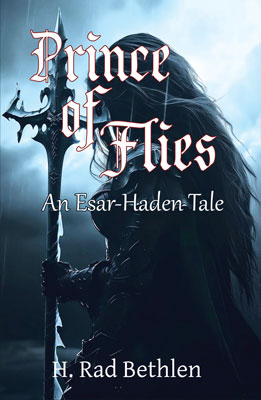
Prince of Flies
Prince Lewin was sent with his father's army to conquer Pwyll. When they arrived at the entrance to the dark elves' subterranean city they found the cave plugged with boulders. The desert pavement spread out all around them. In the distance the shadowed peaks of the Black Ogre Mountains hid the setting sun. The town of Seven Rivers lay just on the horizon, the glow of its fires the last stronghold of civilization. It was going to be a long siege but they were prepared--or so they thought.
The next thing the prince knew was the bite of cold. Gone was the heat and dust of the desert. In its place was snow, ice, and wind. He figured magic had transformed the desert into a tundra. He figured it would pass. But the Black Ogre Mountains could not be seen. Seven Rivers had vanished from the horizon. There were no familiar landmarks on the featureless white plain that stretched out in all directions.
Prince Lewin panicked. The army was lost. Only the dead horses remained, half buried in the pitiless snow. But Lewin was not alone. He heard chanting on the wind and found a dark elf priestess wrapped in furs. She promised him safety and salvation, she promised him power, a power greater than that of his father, the king. All she asked was for him to listen. It was either that or die.
Buy Prince of Flies-Kindle on Amazon
Buy Prince of Flies-Paperback on Amazon
To read an excerpt click here

Savior/Destroyer
When a rich and powerful elven wizard request a mercenary killer from the local thieves' guild he's sent Esar-Haden, a dark elf rogue. The two men form a stark contrast, and it's not just the colors of their skins. But a job is a job and Esar-Haden, perpetually down on his luck, needs the gold.
The job is explained. Esar-Haden feels up to it. Of course, complications pop up immediately. One is the wizard's naive and innocent sister, Esmé. As soon as Esar-Haden lays eyes on her he's smitten. She's curious about him, too, but afraid.
The next complication is the wizard Esar-Haden is supposed to kill. She's even more gorgeous than Esmé but in an entirely different way. Yet again, a contrast. But a job is a job and Esar-Haden needs the gold.
Yet this time he's not the thief--he's the mark. This time he's not the assassin--he's the sacrifice. Esar-Haden knows the danger he's in. He's meet demons before. What he doesn't know is how in the hell he's going to get out of it--and rescue Esmé, too.
Buy Savior/Destroyer-Kindle on Amazon
Buy Savior/Destroyer-Paperback on Amazon
To read an excerpt click here

The Spirited Mistress and Other Stories
House politics in Pwyll, one of the many subterranean cities of the dark elf race, is life or death. This is true both between houses and within. Dark elf culture is matriarchal. The competition between mother and daughter leaves no room for affection or love.
Ufa has risen to the leadership of her house. She is the new Matron Mother. But one of her sisters is slow to see her as such. She behaves as if their mother's death--murder by poison--had freed them all to behave with reckless abandon.
There are two problems with this. Reckless abandon gets you killed in Pwyll and disrespecting your Matron Mother, especially publicly, can get your entire house killed. The other houses are quick to sense weakness.
When such recklessness threatens to humiliate Matron Mother Ufa in front of her peers she must decide how to react. Will she increase her power of diminish her house? Her fellow Matron Mothers look on.
This is the first of four exciting stories in this collection. Also included is Trog in which Esar-Haden must solve his enemy's problem in order to save his own life, Hashishin in which Esar-Haden must see through the illusion of Heaven in order to avoid Hell, and Two Daggers and a Dying Man, Esar-Haden's origin story.
Fans of Esar-Haden won't want to miss this exciting collection.
Buy The Spirited Mistress and Other Stories-Kindle on Amazon
Buy The Spirited Mistress and Other Stories-Paperback on Amazon
Buy The Spirited Mistress and Other Stories-Hardback on Amazon
To read an excerpt click here
The Killing Stroke
"In my old age I find that nothing last forever." Said Vazzo, the founder of the School of Six Hundred Killing Strokes to Esar-Haden, the dark elf rogue. Vazzo is an assassin, yet he is hiring an assassin.
"When the alpha wolf weakens," said Vazzo, "his infirmity threatens the survival of the pack. In such a situation the pack attacks him. He knows this act comes and it is his final duty to fight them and to die with honor. In this way the pack remains strong. They do not conspire behind his back, weaken him, and finally tear his throat while he sleeps."
It was the School, his legacy, that was under threat of being torn apart. He needed Esar-Haden to save it. He could not do it himself. But Vazzo is misguided. His proposed solution is as miserable as suicide. Only he can't see it. Esar-Haden can.
Will Esar-Haden defy the master assassin's wishes and risk his own life in order to bring about an honorable end--honorable to two assassins, that is? Or is it too late to save Vazzo's legacy?
Buy The Killing Stroke - Kindle on Amazon
Buy The Killing Stroke - Paperback on Amazon
To read an excerpt click here

In Memory of a Lost Love
In the shadowed streets and gilded halls of a kingdom ruled by cunning and ambition, one dark elf moves unseen, a rogue whose blades and wits are as sharp as his past is shadowed. Esar-Haden is a survivor, a thief, and a hunter-denying Death a hundred times while chasing fortune, vengeance, and the echoes of a life left beneath the city of Pwyll.
But this night, the stakes are higher than gold or secrets. A corrupt nobleman, a cunning blackmailer, and a monstrous force from the Abyss converge, each driven by desire, fear, or power. As blades flash and hidden magics stir, Esar-Haden must navigate treacherous foes and treacherous desires, racing against time to reclaim letters, treasures, and perhaps a fragment of his own soul. In a world where trust is rare and death is patient, only one thing is certain: survival will demand more than skill-it will demand courage, cunning, and the willingness to confront the darkness within and without.
Buy In Memory of a Love Lost - Kindle on Amazon
Buy In memory of a Love Lost - Paperback on Amazon
To read an excerpt click here
Divided and Other Stories
Divided: Amy Hale is fed up. She's "made it" according to everyone's standards but her own. As she prepares to exhibit thirteen of her paintings she is forced to confront her cynicism. Will she return to the life of an artist or is it too late for freedom and truth?
The Price: Ashley, a former prostitute, and Price Milner, a National Book Award winning author, share one thing in common--fame. But this Pretty Woman story hasn't been a fairy tale. The happy ending wasn't happy. What can a person say when love has lost its voice?
These and other stories, tragic and comic, await readers of this contemporary collection of short stories by H. Rad Bethlen.
Buy Divided and Other Stories-Kindle on Amazon
Buy Divided and Other Stories-Paperback on Amazon
To read the first story click here
Breaking the Reign of the Dead
A free Pathfinder RPG novel.
Kemnebi, the chancellor of the Blood Lords, has an epiphany while rewriting the legal code that governs the society of Geb. He realizes that the ultimate price of undeath is the denial of the soul's deepest need: to grow.
Kemnebi is pained by the irony of developing a legal framework to protect a culture whose inevitable fate is stagnation and decay. He tries to convince his fellow Blood Lords that Geb itself is fundamentally flawed and that the entire concept of a society of undead needs to be re-examined.
His initial idea is to reform from within; however, he faces immediate resistance. This resistance becomes so overwhelming he is forced to abandon all efforts at reform from within and must do so from without, making him an enemy of the nation he helped to build.
Will Geb allow his nation to be reformed, either from within or without? Does he care? Or does his obsession with revenge blind him to all other concerns? When he sees the opportunity to strike against his nemesis, Nex, his actions affect nations. No one--not Kemnebi, not the Blood Lords, not even Nex himself--can escape the repercussions of Geb's actions.
This epic tale of intrigue and strife spans three nations--Geb, Nex, and the Mana Waste--and has a cast of characters that includes Geb, Arazni, Kemnebi, the Blood Lords, the Council of Three and Nine, the Arclords, and many others.
H. Rad Bethlen, the award-winning fantasy author, rewards fans of the Pathfinder Roleplaying Game with every word of this exciting, fast-paced, action-packed story.
Available in Kindle, paperback, and hardback on Amazon.
Breaking the Reign of the Dead Paperback
Breaking the Reign of the Dead Hardback
Breaking the Reign of the Dead Kindle
To read the first chapter click here
We now have a merchandise store! You can get everything from cell phone cases to shower curtains! Please visit our store at: Red Bubble.
Stop by H. Rad Bethlen's author website for news and updates about our favorite author. Or visit his Amazon Author's Page.
To contact H. Rad Bethlen please write to:
2003 N. Kennedy Ln.
Normal, Il. 61761
The following are the first three chapters from Shards of Nirvana.
A Dying Wish
Parallax sat next to his father, looking down into his face. The flame of a single candle lent its warm hues to his father's washed-out flesh. Parallax looked through the window and saw, illuminated by the silvery glow of the moon, his mother's grave. He held his father's hand, feeling the warmth of it, feeling the pulse within-distant and weakening.
"Death," whispered his father. He opened his eyes, staring upwards into darkness. "Is there more to life than suffering and death?" Parallax did not answer. "I tried to warn him. I spoke truth to power and for that I was banished."
"I know, Father."
The father turned his dark eyes to his eldest son. "On my deathbed of whom do I think? Of my wife who proceeds me? My children? I think of my Emperor, whom I failed." The dying man returned his gaze to the flickering shadows above. "I cannot be at peace, I cannot die in peace, knowing he is angry with me." He lifted his hand and motioned to the chest at the end of the bed. "Take my poem to him. Remind him of the glory of his father's reign. Such glory can yet be his. Read it to him-as much as he will listen to-and beg," he returned his hand to his son's. "Beg forgiveness for me. I failed at dharma."
"You have not failed at dharma. You have led a righteous life."
"How many men have died in the wars of Sevak? What did his ancestors build for him-for us-and what have we done with it? I advised Sevak-"
"You are not to blame for-"
"I'm dying."
"Father?"
"I can feel it."
"I'll wake Naresh and Dhara." Parallax started to rise. His father tightened his grip.
"No, she is too young and he is too anxious. Son, listen." Parallax sat. "I have groomed you for court life. I have taught you the Vedas. I read the Ramayana and the Mahabharata to you while you suckled at your mother's breasts. Of the Dharmashastas you know every word. I have kept the palms of your hands soft by giving the hard work to Naresh. I have taught you etiquette, rhetoric, logic-" The dying man began to cough. He tried to suppress the noise so as not to wake his other two children. Parallax squeezed his father's hand until the fit passed. "I have taught you all I know of yogic magic, of how to access your chakras, of how to-" Again he coughed.
"Father?" called Naresh, not quite awake.
"I am with him," said Parallax.
"Son?"
"Yes, Father?"
"Beg forgiveness and forgive. Take care of those who love you and whom you love in return." He squeezed his son's hand with all his remaining strength. "Do this to give the soul peace."
Leaving Home
Naresh paced, watching his elder brother out of the corners of his eyes. He came around Parallax and looked down into the sackcloth bag. "You don't have enough food to get there and back."
"I'll buy more when-"
"You don't have any gold and so little silver. Brother," he looked at Parallax, his eyes accusing. "It's as if you know you won't return."
"The road is dangerous," said Parallax. He glanced at Naresh but looked back to his packing. "I may be attacked by bandits and robbed. The less I have the less-"
"Would they take your life?" asked Naresh, placing a hand on his brother's forearm. Parallax did not answer. "Don't go."
"I have to."
"Bandits are the least-" Naresh shook his head. "You know there are," he swallowed the word, afraid of attracting the attention of evil spirits. "How can you-"
"Father."
Naresh spun away and resumed his anxious pacing. "He would not want you killed!" He stopped and stared at his brother. "Father never forgave himself but it's been so long since-" He threw up his arms in frustration. "What difference does it make?"
"It's my duty as the eldest son."
"You are the head of this household now." Naresh returned to Parallax, once more placing a hand on his brother's forearm. "You are responsible for the farm, for Dhara, for-"
"What do I know of farming, Naresh?"
Parallax grabbed his brother's wrist and turned his hand palm up. Next to his brother's hand he raised his own. The difference was obvious. Naresh yanked his hand away.
"What of Dhara?" he asked. "She's still a little girl. A girl," his voice rose, "who has lost her mother and father. Now," he waved at Parallax, "she will lose her eldest brother."
"I have arranged her marriage to Amit."
Naresh grabbed Parallax by the shoulder and turned him. "Brother?"
"They are playmates."
"Yes."
"His family is an honorable one," said Parallax. "They honor the gods and their ancestors. They have more land and animals than we do. Our father was friends with Amit's father. It's a good arrangement."
Naresh nodded his head but was displeased. "I will be alone."
Parallax smiled. "Soon, you will have Vajra and a family of your own."
Naresh sat on the edge of his bed, cupping his chin with the palm of one hand. "Yes."
Parallax went to him and squeezed his shoulder. "I must go."
Naresh looked up. "You take so little."
"Father's poem is heavy."
Naresh rose, wrapping his arms around Parallax, restraining him with affection and fear. "Stay."
"Brother," said Parallax, exhaustion entering his voice, for he did not wish to begin the argument anew.
"Why have you renounced your inheritance?"
"The dangers-"
Naresh released his brother and began to pace. "Yes, the dangers of the road." He spun and pointed at Parallax. "But why renounce your inheritance?"
"Should I die it will be better to have made you the head of the household. Really, hasn't this been your farm since you were a boy? Father and I were always bent over books."
"No, Brother, this is our farm, our family farm. We-"
"I know so little of husbandry," said Parallax. "I have been taught to take up a position at court, not to-"
Naresh came to Parallax and once more hugged him. "A position at court?" He smiled and kissed his brother on the cheek. "You will restore our family? You sought to hide it from me? Ah, I know, you did not want to get my hopes up." He released Parallax, went to his bag, grabbed it, returned, and placed the strap over his brother's shoulder. "Go to court, with my blessing! Find your post and return our family to glory and wealth." He laughed. "May the Emperor-"
"I did not-"
Naresh studied his brother's face. What he saw there caused him to turn away. "Are you even going to court?"
"Yes, to fulfill Father's dying wish."
"I know why your bag is heavy." He turned and pointed. "The Aranyakas! You want to disappear into the forest and read those damn books, don't you? A holy hermit! Is that what you want? Just like the one Father forbid you to- Did he give you the-"
"I don't have the Aranyakas."
Naresh spun and motioned to the door. "And there, your kashyadanda with its red-brown rag. You're going to be a hermit, aren't you?"
"A walking stick to knock the heads of panthers and pythons." Parallax went to Naresh, wrapping his arms around him. "I must take Father's poem to the Emperor and beg for his forgiveness. This is dharma. It is right action. You know it to be so."
"Then?" asked Naresh. Parallax released his brother and went to the door. He looked out into the dusty road but did not answer. "Brother," said Naresh, coming to stand behind Parallax. "You are being deceitful. You know that you will not stay at court." Parallax looked over his shoulder, met Naresh's gaze but in doing so was forced to look away. "You know you will not return. Where will you go? What will you do? Answer me."
"You worry too much." Parallax turned to face Naresh. "You must have faith. Pray to the gods and make offerings."
"The gods? I'm worried about you!"
"I will be fine."
Dhara rushed into the doorway and squeezed past her brothers. She went to her bed and began to root beneath the covers. She backed her way out with her doll in-hand. She tried to rush out of the house but Naresh caught her.
"Say goodbye to your brother."
Dhara looked up. "Where are you going?"
"I must do something for Father," said Parallax. Dhara saddened. The death of their father was a fresh wound. Parallax knelt and took his sister into his arms. "I must go see the Emperor."
"The Emperor?" asked Dhara.
"Yes, an important man, the man Father used to advise, before you were born."
"The man in the palace?"
"Yes," said Parallax.
"Will you bring me something from the palace? A doll or a dress?"
"Perhaps," said Parallax, releasing Dhara and rising. "Go play with Amit."
Dhara smiled and ran out of the house.
"You lie to an innocent child?"
"I do not lie."
"How can you bring her back a gift from the Emperor if you're not coming back?"
Parallax turned and took up his kashyadanda. "I'm not needed here. I'm no farmer." He looked through the doorway at the road. "I will fulfill Father's dying wish."
"You've never found peace in-" Parallax looked at his brother. Naresh looked around the room. "In this. Father wouldn't let you. He wanted you to take his former place. To right his supposed wrongs. Father made it clear that this was my place and that yours was at court." Naresh went to Parallax and took him in his arms. "What did it matter what I wanted or what you wanted? And yet, this is my place. I'm happy. I'll be married and have a family. You've never been happy. You're too big for a small place like this. Go to court, find a post of distinction. Be happy there and return our family to glory and wealth. Think of me. Think of Dhara." He expressed his emotions with his eyes and words. "Don't be selfish."
Parallax kissed his brother on the cheek, turned-in doing so broke the hold his brother had on him-and stepped from the house to the road.
A Summons, a Challenge
Ravik floated upon vapors of magic inches above the black, blasted ground of Naraka. Where a traveller would hope to feel soft grass beneath his feet were instead thrust-up shards of iron. Volcanic cinders took the place of soil. Where there is often water-the fluid of life-seeped boiling lava. The air was saturated with the stench of sulfur. A wind blew-composed of screams.
The lost souls of suicides floated across the merciless plain, wailing in eternal misery. The demonic hoarders of souls that lumbered in the distance like deformed giants ignored them, for they-even in that place-were tainted.
The sky above was the color of a darkened ruby. Black clouds raced with remarkable speed, a swirling maelstrom, even though the wind was not sufficient to drive such action. Silence under such frenetic movement was unnerving. Ravik could only discern the horizon due to his command of magic. He could only make out the black-stone mausoleum due to his immortal eyes; otherwise, every direction would appear the same-with no destination possible. He continued on; passing over a low rise, descending into a shallow valley.
When he came out of the valley a new feature had grown on the iron plains: a killing field. He saw thousands of corpses. Many still writhing in agony. He floated over one and looked down. The man rolled from his side to his back-shards of iron snapping off in his flesh. When Ravik looked into the man's face he saw himself; not as he was now, but as he had been-a mortal man.
As Ravik watched, a new wound appeared, as if an invisible blade had struck. A sharp-edged gash opened on the man's forehead. Blood sprayed onto his face, filling his nostrils and mouth. He saw Ravik and reached up-the palm of his hand perforated and bloody. He cried for help, the sound a gurgle. Ravik moved on.
Every corpse in that field of death and dying was his. Each appeared the same. It was him before the Aphelions had removed from him the weakness that is mortality to make him what he was now, an immortal rakshasa.
Ravik was no longer a mortal man. He had a man's body, for the most part. His head had become that of a black panther. His hands were now panther paws but reversed, the palms facing away from his body. His feet too were those of the panther but fortunately, for the sake of function, they faced the right way. He was covered in a sleek coat of black fur. He could see in near total darkness and he had a taste for blood.
Ravik was not aghast at the sight of himself dying beneath his feet. He knew the Aphelions were attempting to frighten him. They could not help it. Fear was their currency. They were both greedy for and generous with fear.
The sight did worry him. The Aphelions had summoned him-troubling in itself. Not only that, they would not allow him to make a magical gate to link his fortress-palace to their mausoleum. Instead they forced him to cross Naraka, to face its dangers, from which he, even with all his power, was not immune. With this thought in-mind, the sight of himself contorted in pain, a thousand copies of him with ten thousand wounds, him dying, him dead, was troubling. The Aphelions had created it, but why? To frighten him? Or did they mean something more?
. . .
He had forgotten how massive their mausoleum was. The black-iron doors before him were fifty feet tall. He struggled to lift the iron knocker. It weighed a hundred pounds. He dropped it. The hollow echo of its strike reverberated for minutes. Once that dreadful beat had dissipated into silence a threatening sound replaced it: the scrape of iron against iron. The doors fell in. The stench of death rushed out-flooding his sensitive nostrils.
Ravik had to squeeze himself through the scant opening. The doors closed behind him, sinking the cavernous space into near-total darkness. It took several seconds for his eyes to adjust. When they had, he looked around.
The walls of the entrance chamber were so far back he could not see them. The vaulted ceiling rose a hundred feet above. Unbelievable riches in gold and silver coins, gems and jewelry, swords and armor, art and artifacts of every description were piled all around, spilling across the floor. One pile alone would fund an empire through a dozen wars of conquest. The entrance chamber contained enough wealth to make every mortal man as rich as a king. Yet Ravik dare not pocket a single coin, for the treasure was yet another tool the Aphelions used to corrupt man and turn him from the path of righteousness.
Ravik heard mocking laughter and looked. A towering woman-three time his height-approached and stood looking down at him. A sneer marred her otherwise graceful features. She was hairless, without even brows or lashes. She was slender, her stomach flat. She had four arms, two from each shoulder, ending in long-fingered, delicate hands. Her fingernails had been ripped free. Blood dripped from the nail-beds. The blood splashed against her nude body and formed a skin-tight suit. Her eyes, which were opaque and without pupils, wept blood. Her cheeks were stained red. Whenever a drop of her blood hit the ground it turned into a scorpion. When two scorpions were near they grappled and stung one another. In this way death danced at her feet.
She pointed to Ravik and laughed, the sound haughty and insulting. A line of blood was cast by her finger. Part of it ran across Ravik's chest. The drops became scorpions that clung to him; their barbed tails threatening. The towering, blood-soaked woman turned and sauntered down the hall, leaving a living trail behind her. Once her attention was no longer on him, Ravik scraped the scorpions free and snarled.
"What did you think?" hissed a voice from the shadows. Ravik looked. What had once been a man but was now a humanoid bipedal lizard walked awkwardly forward, his legs bowed, a fat tail slid on the floor behind him, causing coins to cascade with every swoosh. He wore a robe of tattered cloth. Dozens of talismans and large keys on twisted gold chains hung around his thick neck. A ceremonial dagger hung from his belt. He stopped before Ravik. His forked tongue slipped between his thin lips then returned to its humid home. He reached out, as if he were going to drag his filthy claws across Ravik's face, but stopped himself and pulled his hand back.
"Think of what?" asked Ravik, crossing his muscular arms in front of his chest. His many bracelets and magical rings glimmered with an inner light. He had enchanted them himself, their magics providing layers of protection. Ravik was dressed for the role he had known it to be his destiny to fulfill; as a tyrant, a subduer of free peoples, a maker and keeper of slaves. His clothes were made of the most luxurious cloth, embroidered in gold thread, adorned with gems. The sword thrust through his sash was near-priceless. Gems studded the entire length of the scabbard. He exuded opulence and power.
"The field of corpses?"
"They meant nothing to me." Ravik scoffed. The lizard-man was squat and he enjoyed looking down at him.
The lizard-man laughed, or tried to laugh. A rasping click was all he could manage. "Do you think they're pleased with you?" He turned and began to lead Ravik deeper into the vast mausoleum.
"I have done all they have commanded of me."
The lizard-man glanced over his shoulder and once more made his rasping click.
. . .
The hall at the heart of the mausoleum could have housed a small city. The massive pillars stood like a well-spaced forest of smooth, bark-less, branchless trees. They disappeared into the darkness above. Ravik could not guess how high the ceiling was. He couldn't see it nor did he feel its weight. The hall was featureless, other than the pillars. The lizard-man slowed to a stop and waved Ravik forward, his scaly, clawed hand trembling.
"Advance no further!" cried the lizard-man. Ravik turned. His guide was half-hid behind a pillar, looking up, his eyes wide. He glanced at Ravik and whispered, "They come." With this he spun and rushed as quickly as his bowed legs could carry him out of the grand hall.
Ravik turned, knelt, and bowed his head. He could feel their approach. Despite all his arrogance he began to tremble. The Aphelions were god-like beings of terror, horror, and decay. He had yet to see one, despite all his dealings with them. He believed that to see one would cause instant death. He knew the Aphelions were the most powerful of Shiva's minions. Shiva would, in time, destroy the universe and all that resided within. The Aphelions would help him.
He felt their presence. They loomed over him. They created their own gravity. They gave off their own atmosphere-a suffocating noxiousness. Being near them was akin to being buried alive in a mound of rotting corpses. They advanced like terror advances-silent and overwhelming. Ravik felt their attention on him. He was paralyzed by fear. It took all of his considerable will to start his heart beating again, to convince his lungs to draw air.
He will achieve glory. He will join them. You have failed.
They spoke in unison, their combined voices an angelic chorus; melodious and pleasurable. The contrast between utter terror and sublime beauty made his skin crawl.
"It is not certain," he said, finally summoning his voice.
We rewarded you too soon. Your work was not yet done. The error is ours but you have failed.
Ravik shot to his feet and whipped his head back. He clenched his fist and held it before him. These actions were driven by the emotion of pride and could not be controlled. Thankfully he did not see them, but only a darkness his sight could not penetrate. "He will not join them! He is weak!"
He was stronger than you.
"I am stronger than Ravana!" Ravik pounded his fist against his chest. "I am the ruler of all I surveil! I defeated him once and will do so again! You doubt me?"
You have failed.
"No! He shall fail! I will ruin him!"
Ravik's voice rebounded among the pillars and returned to him thin and weak. The Aphelions were gone. Their gravity, their stench, the weight of their power, and the fear they caused were all absent. He was alone. He relaxed his fist, closed his eyes, and breathed deeply.
"They will take back everything." He opened his eyes and studied the emptiness where the Aphelions had stood. "Unless-"
Buy Shards of Nirvana - Kindle on Amazon
Buy Shards of Nirvana - Paperback on Amazon
The following is the first chapter from Throw Away Lives.
A Fate Reflected in Moonlight
Not everyone is born with the same opportunities. Some have it good, some have it bad. Some are born with the right genitalia. Some with the wrong. Some are born high while others are born low, into powerlessness, poverty, and everything that comes along with it: ignorance, hate, cruelty, and suffering.
In other words, the die is cast long before you get the chance to throw it. My own birth was to a low house, a subservient house, and I had the misfortune to be a male born after three females. Mine was a miserable lot from the start. The gods didn't do me any favors.
The light shifted. Esar-Haden looked up from his journal to the iron-barred window in the stone wall. He leaned forward. He could just see the curved edge of the waning moon. He was writing by its blue-hued light. He was a dark elf--a member of that war-making, subterranean-dwelling race, long ago separated from their peaceful, nature-loving cousins of the forests and plains--and could see fine by such a feeble glow. He thought it ironic that the chill of the stone floor had caused the swelling of his left eye to diminish enough that he could now see out of it. The stone had made for an uncomfortable yet medicinal pillow.
The movements of a rat drew his attention. He kicked out, his leg irons scraping the granite. The rat paused, its dark eyes regarding him. Finding no cause for alarm, it resumed its search among the rotted hay. The air was fouled by its decomposition. Esar-Haden was already accustomed to the stench.
"For shame," he said, the scab on his upper lip cracking. He tasted blood and spoke with greater care. "I should not begrudge you the hope of a reprieve from hunger." He began to smile, thought of the scab, and didn't. "This is your home. I'm merely a shadow of a man passing through." The rat found a morsel, grasped it in its human-like hands, sat back on its haunches and began to gnaw at it.
"They got me," continued Esar-Haden. "I don't know how, but--" The rat turned an ear toward him but its eyes--and the majority of its attention--remained on the bit of stale bread.
Esar-Haden glanced toward the closed and barred door. He listened. Hearing nothing, he turned to his companion. "I didn't give up the gold." He laughed. The rapid swell of his lungs pressed against his cracked ribs. The pain wasn't so severe as to diminish his gallows humor. "Some shepherd boy will stumble upon it, long after I've been hung by the neck. He'll thank the gods for his good fortune! Little will he know." He couldn't help but frown. The pain from his wounds, given to him by the Sheriff and his men, dampened his spirits, as did the thought of his gold--stollen though it be--falling into the hands of someone else.
"As for me?" He dipped his reed pen into the vial of ink sitting just to the outside of his right thigh. He held the journal steady with the first two fingers and thumb of his left hand, the others being broken. He had constructed a splint for them out of a scrap of wood he'd found in the dungeon--thankfully within reach--and a bit of cloth torn from his shirt. "I won't be bothering you much longer."
The rat regarded him. It licked the last crumbs from its fingers, turned, and scampered into the shadows.
Buy Throw Away Lives - Kindle on Amazon
The following is an excerpt from To Trick a God.
I have not heard your pleas in a long time, Maret.
"I need you."
Need?
"Devinti is dead. The young are clever, cruel, and desperate."
The children of the revolution turn on their parents?
"Yes."
You fear them?
"Yes."
Destroy them.
"They are endless."
Doubt? From you?
"One must consider failure."
Meaning?
"What will become of me after death? I have sinned."
How does one escape the repercussions of one's actions?
"I'm asking you."
. . .
He stood behind Maret. He never faced her. Not even preternatural speed, lent to her by
magic, could move her fast enough to catch sight of him. He had always been and would always remain a mystery.
"Can he do it?" she asked.
I can think of no other.
"Will he?"
From behind--silence.
"The price?"
From behind--laughter.
"Take me to him."
. . .
The valley was a cornucopia of verdant life. There was barely room enough to pass--the flora pressed. The air was dense with fragrance. Countless birds fluttered from branch to branch, disappearing into pockets of sun-edged shadow. A copper-colored fox passed by Maret and her companion, brushing against them. He stopped to sniff Maret's bare ankle before ducking under a cluster of drooping dock leaves.
"Here?" asked Maret, incredulous.
A cave.
Maret folded back the leaves and branches. She slipped her bare toes beneath delicate flowers, her sandals tucked under her left arm. She was afraid to snap a twig, crush a blossom. She was afraid even of scuffing moss from a stone. Who knew what might anger him? With agonizing care she crossed the valley floor. As she approached the base of the cliff she saw the shadowed hollow. It was tall and narrow, like a black-bladed dagger thrust up from the earth, lodging itself in the stone. She paused.
Butterflies danced before her, flitting through the air. She watched them--annoyed. When they passed she intoned a spell. It was a simple cantrip, one that alerted her to the presence of magic auras. Her senses exploded. It was all magic. She clenched her eyes shut and ended the spell. After a minute of dazed and wobbling uncertainty her senses regained their courage and function. She heard chuckling behind her and ignored it.
She slipped sideways into the narrow cave. It curled into the stone. She was forced to shimmy herself along, smashing her breasts, scrapping her knees, wedging herself deeper and deeper until she could go no further. ‘At least he's not behind me,' she mused. She glanced to her side. If the demon with whom she had long ago struck a bargain had followed, she would finally lay eyes on him. There was only darkness. She began a minor spell. The humid darkness of the cave was dispelled as the flickering light came into existence.
Maret would have leapt in surprise, were she not held immobile by the stone. She was face-to-face with another. As she calmed and took in more visual information she discerned that what she had taken to be another fully realized presence was nothing but a face carved in the stone, a partial face at that. A small section of the cave wall had been pressed back into a concave shape. Rising out of this bowl was the broad forehead, heavy eyebrows, high-arched nose, and square cheeks of an aristocratic face. It was as if a clay-worker had come into the cave, pressed her thumbs into the stone, and left her work incomplete.
The eyes opened and stared with stony indifference.
"I--" Began Maret.
Emotion overcame the face: profound sadness. The "skin" around the eyes crinkled. The muscles that directed the cheeks pulled them taunt. If stone could weep it would have. The emotion reversed, returning to normal. A moment later came irritation. The brow furrowed, the eyes narrowed. The anger was subdued but present. The effects of the emotions were so complete they nearly silenced Maret. She was, however, a woman not easily silenced. "--need a shabti."
The face lifted, grinding, moving against itself, until a pair of broad, sculptural lips came into view.
"A vessel?" asked the face of stone. The trio of syllables came ponderously, echoing in the small space.
"Yes."
"To contain?" Again the trio reverberated.
"Sin," said Maret.
"Sin?" asked the face of stone.
"Can you make such a thing?"
The mouth curled downwards. The face sank, the lower half disappearing beneath the thumb-pressed stone. The eyes closed.
"I fear death," admitted Maret.
He made no response.
"I fear," she searched, "judgment."
The face emerged fully. The eyes opened.
"I've lived more than two centuries," began Maret. She appeared in her mid-twenties--part of the bargain. "I've made a pact with a demon. I've slaughtered hundreds, thwarted the fates of thousands, subjected entire peoples to tyranny." The face remained blank from emotion. "What awaits me?" Maret studied the face in the stone, the face of stone. It fluctuated between the lifeless chill of sculpture and the animated warmth of life. The features did not move. It was merely energy, consciousness, that seemed to come and go. Even when this consciousness came, was present, there came no response to Maret's plea. She made another.
"Will I be judged?"
Something affected the eyes. Again, not material, but energy. The word "judged" brought forth a heightened consciousness. Despite this, the stone did not speak.
"I want a shabti to take my place," said Maret, "to be judged, to be punished."
"You want to trick a god?" asked the face of stone.
"Can it be done?" asked Maret.
The face grew contemplative. Silenced reigned for some time. "She judges every soul that passes beneath her never-blinking gaze," said the face of stone. "Each soul is naked before her."
"It can't be done," said Maret, defeated. The full weight of her sin bore down upon her.
"A man beholds a river," said the face in the stone, his deep voice resonating in the small space. "He cups his hand, he drinks. The river is in this man, wherever he goes."
The face did not elaborate.
Maret, baffled by the metaphor, asked, "Meaning?"
"What is a soul?" asked the stone face.
"I don't--"
"If a soul be a river, can the soul be drawn from? If drawn from, what becomes of that which is taken away?"
Maret could not answer.
"There is but one soul, one river--divided--to which all drops return. First," the face fell silent, studying Maret with hard eyes, "these drops must be--purified--before they return home. This is what you fear."
"Yes," admitted Maret.
"It follows," continued the face of stone, "that to be purified in advance is what you wish."
"The shabti?"
"To gather the water which you have fouled, to separate it from the clean. To subject it to--purification." The stone eyes regarded Maret. "This can be done."
"Yes!" Maret was giddy. The silence of the stone face dampened her premature celebration. She studied it. "The price?" She could only whisper the question.
"All water returns to the river," said the sculpted face. "Yet not all water takes the same path home."
Maret grew nervous.
"I can draw the brackish from the fresh. For this, I will have a handful to raise to my lips."
Buy To Trick a God - Kindle on Amazon
The following is the first story from The Pathfinder Collection
The Preservation of Captain Haifa Brindisi
A Pathfinder RPG Story
Being a record of tragedy, found in the wreckage of the sailing ship Dragon's Star; which, having been damaged while at sea and later smashed amongst rocks in the Ironbound Archipelago, was the scene of much suffering.
Let this stand as a testament to the weakness of the body, the capriciousness of the mind, and tell that the soul does suffer both. I am the only survivor of the ship Dragon's Star. I was born and raised in the fishing village of Arsmeril, on the northern coast of Varisia. My father was from Ustalav, having fled the curse of that soil. Nay, he did not suffer any soil, but passed from land to sea, to be seen no more. What I have of him is precious little; although, it can now be said, and you shall come to believe, that he did not leave me bereft of the gifts of his blood.
I was raised by my mother and uncles, simple fisherfolk; hearty, silent, and devout to the gods. I learned by heart The Eight Scrolls and can recite from memory the Hymns to the Wind and the Waves, being often of the necessity to call upon the guidance of Desna and the mercy of Gozreh.
I have many male cousins, but none were so by nature drawn to sea than I, and although I was a girl, my uncles did not keep me back, seeing that salt was in my blood. By the time I could balance enough to walk I had my sea legs. While the other girls of the village dreamt of the Eagle Knights of Andoran, or some suchlike romance, I was longing for open seas and fair winds.
If I had known what my fate would be, that I would not sail at the pleasure of fair winds, not at all, but be put meanly to land by the cruelest winds any sailor has suffered, I would that an Eagle Knight had taken me away and kept me in his castle, a pretty bauble, safe from all knowledge of sea and self.
Know that we suffered from a total want of all that would sustain life. The Dragon's Star had been battered by waves and was leaking profusely. We had endured relentless winds, which had the sinister nature of the fey. Indeed, we worried that some sea spirit was revenging us for an unknown injury.
First, two pair of our foremost main shrouds on the larboard side were taken by the wind. The next morning our two fore main shrouds on the starboard side were carried away. We applied runner and tackle for the security of the mast. The weather was intolerably bad, day and night. By the next morning the wind calmed. We sang hymns and made offerings to Gozreh. Despite this, the next day a sudden wind came and, to our unspeakable horror, tore clean away the forestay and foresheets. Not only this, the foresail was rent in pieces. We had no recourse and tried our best under a balanced reefed mainsail.
The sea was as mountains upon us and it was here that the ship began to leak in earnest, the wood strained beyond its natural constitution. That night the tack of our square sail gave way. The sail was torn to tatters. Our flying jib was blown overboard. Despite all this we made way, our only bit of canvas being our mainsail. Our ship sat low due to the water we'd taken on. We worked the pumps without respite. Gozreh was not finished. After a calm that put us at ease, a gale blew hard from SSE and took apart our mainsail. We were at his mercy.
. . .
The Dragon's Star sailed out of Magnimar. We'd a load destined for Promise, on the island of Hermea; yes, the home of the great gold dragon, Mengkare, or so it's said, none I know of having seen him. We'd made the port once before and little can be known of the city, for a high, red sandstone wall and gates of burnished bronze keep all within secured against intrusion from outside. We were blown NNW and figured ourselves closer to the Mordant Spire or Syranita's Aerie then Promise; although, we had no way of knowing, having no sight of stars, nor sun, nor land.
A great deal of our stores were flooded, despite our efforts to preserve them. Much of the cargo was of no use. We had only some small amount of flour, sugar, dried meat, raisins, wine, but precious little fresh water. We rationed these but my men, against orders, took the wine to excess and the rationing was forgotten. The storms raged and we knew not which way the wind took us. If we passed beyond the Mordant Spire all was lost, for no ships sail those waters.
We had among us a priest of Gozreh, Timmons, who we adorned with the title of Saint. He was an old sailor of many campaigns. He had seen the Eye of Abendego and many other wonders. He'd been shipwrecked twice before, the second time suffering forty-one days on a barren island. He was of great aid to us. Not only was he immune to the hardships of the sea, he could provide food and fresh water by means of divine largesse. We could scarcely believe our misfortune-and his-when a wave took him overboard and carried him out of reach. He disappeared, and with him our hope.
I cautioned the men against wine, for it does little to aid under such circumstances. They refused to drink the water, convinced it was brackish. The wine being more plentiful, they preferred it. What little water there was I retained, it being my only advantage against Fate. The men were constantly warming the wine, for which they maintained a small fire. It got so that the smell of it was noxious to me.
We'd been thirteen days at the mercy of the storm, tossed terribly, half-sunk, and without means, when I retired to my cabin to await the arrival of Trelmarixian, the Horseman of Famine, for he was surely stalking us. By this time I was emaciated with sickness. Despite having hooks in the water there came no fish. I kept within arms-length only this journal, an ink pot and quill, the dirty water, and Saint Timmon's wand. I must tell of this.
Timmons had fashioned a wand out of an oar that he had with him when he'd been forty-one days upon the rock. The oar, his trousers, and his shirt, were all that had come with him from the wreckage of the Ruby Prince. This oar was his means of survival and rescue. He used it to club turtles and crack their shells. He resorted to drinking their blood, there being no fresh water on the island, and gathering their meat by use of sharp-edged stones. He found the highest point and planted his oar, using his shirt as a flag. A ship, the Kantaria, which had been blown off course, saw the shirt-flag and sent a boat to investigate.
Timmons brought his oar from that desperate place and, feeling a certain affection for it, whittled it down to something manageable. This he enchanted with all sorts of useful magics. One of its enchantments was the calling down of a pillar of fire, which proved a deterrent to piracy. This wand was in his quarters when he was taken by the sea. I retrieved it, more to preserve the old man's memory, than to make use of, for I had no learning of magic and knew not how to operate it.
. . .
After a fortnight of hard blowing, the sea calmed. We were adrift. The men came and said they were hungry and having no recourse were going to draw lots to see which among them would sacrifice himself to preserve the rest. They wished my blessing on this demonic pact. Perceiving them in liquor, I begged them to wait out the day, hoping that our deliverance would come presently. They argued my request, saying what had to be done best be done now and why prolong our suffering.
They said they'd eaten all the leather belonging to the pumps, cut their shoes to strips and eaten those, and had even eaten the buttons from their coats. I warned them against the damage such an act would do to their everlasting souls. I beseeched them to pray. They said there was hunger to contend with, damn prayer. They said they cared not if I acquiesced, having come to me out of respect for my former responsibility as Captain, although they contended that circumstances had made all equal.
I told them I would never condone such an abhorrent act and while I could do little in opposition I would not give the order nor partake of their sinful feast. They responded that they required not an order and as to eating or not eating, I was free to follow my own inclination. They left but soon returned and said that they'd come together and drawn lots.
Know this, of those left all were human with one half-elf, who had been my steward, his name being Melorca. They said that the lot had fallen upon him. He flung himself at my feet, pleading that I do something, but I was powerless. The men drug him from my cabin. The manner in which they'd previously gone away to converse amongst themselves, and how the lot had fallen, gave me the idea that the half-elf had been sorely treated. Although, in all honesty, it surprised me that they'd even pretended to treat him as equal to themselves.
They dragged him to the steerage and pierced his neck at the base of the skull. This I was told of later. They cut him open and began to extract his entrails, wishing to fry them for dinner. One man, Dorset, was so taken with hunger he cut out Melorca's liver and ate it then and there, despite the fire being at-hand. He paid for his impatience. That night he went raving mad and was thrown overboard by the others, this, despite their wish to preserve the meat of his body. They were fearful of gaining his condition, should they partake of him.
That evening I heard one of the men say to the others, "Even though she would not consent our getting of meat, let us give her some." One of them entered my cabin with a piece of Melorca's flesh, and offered it to me. I raised the wand and said I'd rather burn him to Hell and the ship with him, then resort to such an act, and further dared him to return a second time with such an offering.
Despite their earlier excesses with both wine and stores, the men rationed Melorca's remains with the greatest of care. All this time I ate nothing, only sipping now and again of the water. Knowing that I had condemned them, and knowing too that their hunger should return, I expected some violence to my person. I slept little and kept Timmon's wand in-hand-as a bluff.
A few days after the last of Melorca had been consumed they returned to my cabin. They said they had seen nothing of land nor sail, had caught no fish, had no fresh water, and nothing else which would sustain life. They again asked for my blessing over the choosing of lots. Furthermore, they argued that all this time I had partaken of no sustenance and surely must be too weak to remain stubborn.
I argued against another act of murder. What good had the half-elf's death done them, for they were once more hungry and desperate? They said lots must be drawn. Seeing as I could do nothing to prevent it, and seeing how unfair their earlier selection had been, I tore a sheet from this journal into pieces and wrote everyone's name upon a fragment. These went into a can from which I drew a name.
The man whose name it was, El-Barek, a sailor who had come from far away Rahadoum, a man of great fortitude, beseeched his fellows: "I ask no god to help me, for they've done enough to damn us all. I ask only for five minutes to reflect upon my life." This was granted to him. Afterwards, he walked willingly into the steerage and met the same fate as Melorca.
I had suffered more than I ever thought I could endure. I had found a state well beyond weakness. I could barely keep my eyes open or grip my pen. It has taken every effort to keep up a journal.
I drank the last of the water, closed my eyes, and prepared to die. Some time later, I know not how long, I awoke with a greater thirst than I previously had. There was a rich taste upon my tongue. I found the strength to sit up. Besides me was one of my men, Hoskuld, an Ulfen. He held a wooden bowl in his hands, filled with blood.
"Quiet," he said. "Trelmarixian is close. Protest not, for it is too late. Drink." With this he held the bowl to my lips. I drank. I drank not only that single bowl of El-Barek's blood but many. I slept well for the first time in memory and was so completely restored that I was able to leave my bed and walk amongst my men. Indeed, I was so fully restored that I felt not at all the ill effects of starvation, nor of dehydration. The men gazed at me as if I were a miracle. Even though they had consumed Melorca and were now consuming El-Barek, they had little health, keeping just out of reach of the Horseman.
The sky was clear, the sun especially bright. I found that it pained me to remain under it. I found also the smell of El-Barek's cooking flesh to be revolting. The aroma coming from the pail of his blood, however, was so agreeable that before I was aware of myself I was drawing it out with cupped hands and drinking as a glutton.
This made the men wary. They offered me meat but I declined. I was aware of their judgment and returned to my cabin. I licked and sucked every crevice of my hand's flesh. The taste of blood was intoxicating. I sat on my bunk in a state of unwholesome wellness. It was a pleasure to be out of the sunlight.
Despite all I had drunk, I could not refrain from obsessing over El-Barek's blood. I began to jealously desire it for myself. That evening, as soon as the sun fell below the horizon, I went to the deck and found the pail empty. This aggrieved me more than reason would suggest. I was furious and kicked the men awake to inquire if they'd thrown the blood overboard. No, they said, they drank it. I began to accuse them but caught myself and returned to my cabin.
I was too agitated for sleep. I felt that I'd been wronged by my men. I believed that El-Barek's blood was mine. I was in a near frenzy when I came to myself. Where had such thoughts come from? Was I truly so desiring of human blood that I planned vengeance upon those who had denied me?
It was then that I understood why I had been so completely restored by El-Barek's blood. I understood why my father, who I always thought dishonorable, had not stayed to raise me, but had taken a boat and gone alone upon the water never to return. I understood that it was not the cursed soil of Ustalav that my father fled from, but the curse within himself. My father, although he had once been, was not human, nor was I entirely human, and had never been. They've a term for my kind, a term told in stories to frighten children, a dhampier. The living offspring of a vampire. A live-born undead.
I barricaded myself in my cabin, fearful that the craving for blood was too powerful a lure. I feared not my men, I feared for them. In time my men came to the door, beat upon it, and announced "land ho." I freed myself and went to the deck. Indeed, there was land. We rejoiced. Here might be civilization and with it hope. If not people and their works, may there at least be fresh water and wild nature with all her bounty. We were at the mercy of the wind and waves. We had not even oars, we used prayer instead. As if by miracle, the waves carried us to the island.
Yet, the miracle failed. As we approached we saw that the island was barren rock. Worse than this, we were being carried toward it with haste. There was no shore upon which to make a safe landing, only sharp rocks. We braced for impact.
. . .
The ship was smashed upon the rocks. We made our way onto the island. It was but little larger than the Dragon's Star and completely devoid of life. Nor was there a spring. There were some divots and natural bowls which we cleaned out in the hope that rainfall would fill them with fresh water enough to drink. Each man watched his divot as if water would appear by necessity alone. Would we once again resort to lots? Not I, for I was twice as strong as all my men combined and could overpower them.
No, there would be no lots. There would be no killing of one to preserve the rest. My men were for me. They held my nourishment within. All the blood on that island was mine and would be used to keep me alive until the time when Desna, the goddess of luck and travelers, should vouchsafe my deliverance. If she did not, then the blood of my men would serve only to prolong my misery, nothing more. As to their misery, was I not relieving it?
. . .
The last man was two weeks dead when I accepted the will of the gods. I sucked his blood until it was no more. His body was so drained, so light, being only bones and flesh, it caught the wind and sailed when I kicked it from the rock. I was reduced to my previous state, one of utter weakness. Once more did the Horseman of Famine, that prince of starvation, stalk me. I had done all for naught; sacrificed my soul, my salvation, and secured eternal damnation, for what? A few extra weeks of life upon a barren rock.
. . .
I was in the ship when I heard a voice. The remains of the Dragon's Star had been tossed high enough on the rocks to remain out of the water, and thus had drained. It was the only place of shade and, while certainly not comfortable, it was the only respite afforded me. I was near death and thought myself delirious, when one man inquired of another, "Signs of life?" I turned my head to gaze out of a hole. I saw a man pass by. He was studying the wreckage but had not seen me, sunk in the gloom.
I thought him a delusion and dismissed all thoughts of rescue; which, I had long abandoned in favor of death. Yet the voices continued. I crawled free of the wreckage and saw that a boat rowed close. Five men sat within, fresh, young, well-fed, and shocked to see me. They had come from a ship at anchor, to which they pointed. I saw the King's colors, King Eodred of Korvosa. I was saved.
. . .
I pen these last words with haste. I must leave my record here, in the Dragon's Star. I dare not take it with me, for fear of being found out. Can I digest human food, or must I now, and forever, subsist on human blood? I shall learn while aboard the Belde, for that is the name of the ship.
I will say nothing to my rescuers of what has transpired, or of how I managed to outlive my men. It is enough to know that I leave the truth to rot upon this barren rock as the gods left me. I shall pray no more, but, like El-Barek, whose blood awakened me, I shall exercise my own reason, rely upon my own strength, a strength which has saved me while the gods remained aloof and uncaring. I shall go to Ustalav, to learn what I truly am, or perhaps to distant Geb, where I need not fear.
Haifa Brindisi,
Captain of the Dragon's Star
Buy The Pathfinder Collection - Kindle on Amazon
The following is the Introduction to Teens Telling Stories.
Do you often have moments of inspiration in which you think of a character, scene, mood, a bit of dialogue, or a story world?
Does your imagination leap to characters in action? Are your characters thrust into danger and conflict? Do they love and hate? Are they flawed and heroic--like the great heroes of myth?
Can you see your story world in your mind's eye? Is this world so rich with detail that you can transport yourself there? Are your imagined worlds so interesting that you would rather be there than here?
Can almost anything inspire you? When you're reading a book, watching a movie, or playing a video game, does your imagination race ahead, predicting what comes next? Do you get so involved that you forget there's a real world out there?
Can you get so caught up in these imagined characters, scenes, and stories that your heart races and you can't wait to write down or otherwise capture these inspired moments? If so, you may be a storyteller.
Congratulations, it's a wonderful gift! If it gives you joy to explore your imagined worlds then use this gift. That's what this book is all about. The goal of this book is simple: to help you tell great stories.
You may wonder if you need help. You may not. You may possess so much talent and enthusiasm that you can do it all yourself. However, the art and craft of storytelling is tricky. You might have run into this already.
Let's say you get inspired. Your imagination rushes forward with characters in conflict, a story world, a mood, a scrap of dialogue, or the beginnings of a plot. You start writing, but after an initial burst the story slogs to a standstill. You aren't sure why? Maybe the moment of inspiration has passed. Maybe you hit a snag. Maybe you wrote down all that was in your head and now you're not sure what to do.You feel lost and uncertain. You put down your pen or turn off the computer. Maybe the story you were so excited about, that seemed so promising, now seems like a riddle. Now you feel the opposite of inspired and enthusiastic. In time you recover and think of something new. You can't wait to tell this new story. You forget that the last one didn't quite work. Or, if you remember, it doesn't matter. Maybe this new story works, maybe it doesn't. You won't know until you tell it.
That's what's so wonderful--and so frustrating--about the art and craft of storytelling. John Truby, the author of The Anatomy of Story, said that, "Storytelling is the most difficult craft in the world." Why? What makes it so hard? Because stories are about you and me, that is, human beings--and we're complicated. So telling stories about us is complicated.
Not only that, but there are proven techniques when it comes to telling stories. At first we don't know what these techniques are. We don't know that they can help us and so we can't use them--at least not intentionally.
There are problems that every story must overcome. At first we don't know what these problems are, how to spot them, or what to do about them. We start writing, stumble upon a problem, and get stuck. If we get frustrated enough we just might quit, and that would be a tragedy because then we won't be using our gift.
This book isn't just about writing, it's about storytelling. Stories have always been told by human beings. For a long time they were spoken, nothing was written down. For a while now they've been written down and widely available in printed and electronic forms. Who knows how stories will be told in the future? Although I will make some educated guesses in a later chapter.
What's certain is that as long as there are people there will be stories. Storytelling is an integral part of the human experience. We think in stories. We collect impressions and facts and we piece these together to tell a story about the world we inhabit, about ourselves, and about those around us.
If we didn't create a story about the world we wouldn't be able to survive. Without a story to make sense of our experiences the world would be a bewildering onslaught of sensory information and random facts. Human beings need stories and so there will always be storytellers.
. . .
The majority of books about writing fiction are aimed at professional writers--or those who want to become professionals. That's great, and at the end of this book I recommend a few other books that will help you learn more. But there's a problem with the professional approach: it's too much too soon for beginning storytellers.
Let's say you wanted to become an astronaut. Someone comes along and drops a mechanical engineering book in your lap, then an electrical engineering book, then an astrophysics book, then--well, you get the point. You wouldn't even know where to begin.
This book knows that you already have all you need to begin: inspiration, imagination, and a burning desire to tell stories. It's on that foundation that you'll build the skills necessary to tell great stories. This book will help you develop those skills.
This book is focused. It won't tell you how to get published, although we'll discuss publishing. It won't get into all of the advanced techniques that professional writers use. Why not? Won't you need those? Yes, in time, but not yet.
What this book is concerned with is getting you from that initial moment of inspiration to a completed story you can be proud of. Once you're there you can go in search of more advanced books on craft.
This book isn't going to talk down to you. You've been consuming stories for a long time. You know a lot about stories. You may not know how to develop, write, or revise a story--not yet. You may not know all the technical terms, but you know how stories work. This book builds on that understanding.
Before we jump into storytelling we need to focus our thinking. In the next chapter we'll take a moment to narrow our horizons. There are elements of storytelling we need to focus on first. There are aspects of being a professional storyteller that we don't need to--and should not--focus on right now.
What are they? Turn the page to find out.
Buy Teens Telling Stories - Kindle on Amazon
Buy Teens Telling Stories - Paperback on Amazon
The following is the first story from The Innkeepers.
Eternal Rest
A group of innkeepers in a fair-sized city had formed a guild. This was really a price-fixing scheme, which they dignified with offices and dues. They met in the taproom of a public house in order to spend those dues and decide, to their mutual benefit, the "fair market value" of what they had to rent. With this new business concluded, they resumed the old; the telling of tall-tales and the ridicule of those whom they had fleeced.
"I ask," began a not-too-proud dwarven man by the name of Reynard. He was an honorable dwarf, as are so many of his race. The honor he kept foremost was this: it was, as he understood it, "dishonorable to let a fool keep his money." You might note his charming take on that old adage.
"Would you turn away coin if the bearer displeased you?" Reynard continued. "There's so many types, all looking stranger than the last. Aye, one doesn't know what to make of them. Why, just yesterday I had a dark elf attempt to claim my best room for a week! And this," he pounded the table with his fist, sloshing the ale in the guild members' flagons, "given the despicable and egregious wrongs his race has done to mine!"
"Answer your own question, Reynard," said Tybalt, a whimsical half-elven bard who had purchased an inn for the captive audience it provided. "Did you put him out with a swift boot?"
A smile raised the dwarf's red mustache and made tremble his thickly-plaited beard. "Put him out? Why, he's there now! Sleeping like a baby! I charged him triple, mind you, deeming it just." He howled at his own capriciousness and added, as if it needed adding, "Drow coin spends as well from my purse as any other!"
"But is he handsome?" asked Dame Bellyn, the only lady of the guild, and a proper Lady at that, even though she "slummed" with the mercantile set.
"I've a mind to speak to yer husband on that point, Madam." Growled Reynard, with a wink.
"Please do." Countered Dame Bellyn. "I should like him found. He's off on another expedition, leaving me to oversee his various interests. Why he feels the wild expanse," she waved a ring-laden hand to take in the whole of the unknown corners of the globe, "requires illumination baffles me. I received a letter stating that his chief cartographer had been melted by acid from the mouth of a black dragon. Melted! I couldn't finish the letter. Oh, the way he dropped that on me, it was scandalous!"
After the laughter had quieted down, "Gray" Kell, a dark-haired, long-faced, narrow-framed, human, although some questioned that, on account of the grayish tint to his skin, the source of his moniker, who, in addition, may or may not be involved with the local thieves' guild, raised a finger. The other innkeepers looked at him. "The question is," he began, looking at Reynard, "not whom would you turn away, but whom would you gladly accept above all others?"
"Adventurers!" cried the group in unison, all except one, a man named Rucklan.
Gam, a gnome, who sat in a high-backed stool to keep him at eye-level with his peers, picked up the thread. "Have I told you about the time I convinced a group of adventurers to leave behind all their surplus gear and loot in my care whilst they went off to the nearest dungeon? They never returned!" The gnome laughed. The rest of the group, except for Dame Bellyn, frowned at his good fortune.
"Perhaps once too often." Observed Tybalt.
"I've one for you," said Rucklan, or simply, "Ruck", who had yet to speak. By all appearances he was a human man in his middle years, stout and hearty, with his chestnut-colored hair combed back and a thick mustache that fell over his top lip, hiding it from view. Ruck knew better than most that in this world one cannot go on appearances alone. "This happened quite some time ago." He began. "Before I was the owner of the finest inn--"
"Hey!"
"Careful!"
"'Finest', humph!"
Ruck held up his hands. "One of the finest?"
The guild agreed to the new terms.
"I was working for one of our own. I was but a lad and he was a blackguard to his very bones --"
"It was him that taught ye, eh?" asked Reynard.
"By harsh lessons alone, yes," said Ruck. "He was the owner of the only inn on a stretch of lonesome road. He felt a town would spring up around him. He was disappointed. Nonetheless, some are blessed with fortune where nature has left them short on intelligence.
"He had come upon a dilapidated building in his wonderings and had taken a fancy to its stones and the carvings thereon; which, on occasion, flashed with the glow of ancient magic. He had a bit of coin, this blackguard, no doubt earned by honest means," to this the group laughed. "Finding a source of clean water nearby and noticing that the road was in good repair, a sign he took as evidence of its regular use, he added wood to the stones and arrived at an inn of which we would all be proud. He hung a shingle painted with two hares frolicking. So the inn became known as the Frolicking Hares or the Two Hares, or the Hares, depending on the interpreter."
Ruck took a drink of ale and continued. "At first he was dismayed. Not a single traveler passed by for days. He had trouble even finding someone to employ. He went out to the road, looking this way and that," Ruck swiveled his head. "He looked down beneath his feet." Ruck mimicked his former employer, then looked at his peers and resumed his tale. "He found, under the dust of time, cut stones. The road had been well cared for, a century prior.
"He spent his time admiring the carvings on his own stones, lamenting his bad fortune, and getting drunk on what beer he'd brewed from the wild hops near at hand. He admired the bluish glow that played along the stones and wondered at the old enchantment. He wondered if they were valuable, these stones, then despaired at the labor of transporting them. He was about to give up the enterprise altogether when he was 'discovered.' I should say that the ruins all around him were discovered. He had unknowingly rebuilt the only visible remains of an ancient city, long forgotten by time and almost reclaimed by nature.
"As it so happens some over-curious young lady toiling away in one of those lofty wizard's towers came across an ancient tome that spoke of the wonders of said city. Her mentor, herself, and a few others, armed and armored, went in search of this marvelous place that time forgot. What did they find? Why, Frolicking Hares. Believe me, they were straight put out. They thought someone had beaten them to it. They soon came to the realization they had an idiot on their hands.
"He was a useful idiot, however." Continued Rucklan. "The wizards were all set to open some pocket dimension in which they could 'rough it'. They saved their scrolls and opted instead for clean linens. My master was pleased. Here were paying customers. They enlightened him as to the true nature of the hills and valleys thereabout. This made sense of the strange stones. The adventurers did some poking about, realized the ruins were not only immense but were also quite dangerous, and after some time and the loss of one of their number, returned from whence they came.
"My, at that point future, employer locked the doors, went to the nearest town, and spread the news. Magic-filled ruins! Priceless treasures awaiting the adventurous! You know--marketing. He hired a few pitiful souls to serve and clean, myself included. We returned to the Hares and awaited the rush of adventurers seeking fortune and fame. Weeks passed. Then months. We had a few visitors, sure, traders passing through. We told them of the ruins. 'More ruins? Humph!' Was the usual response.
"Again my man was close to locking the doors and losing the key. We were at each others throats and were turning into right proper savages under the negative influence of boredom. Then an adventuring party showed up and saved the day. We hopped-to and made them feel like great heroes of myth. They went into the ruins, came out the worse for it, and left our good graces. Word spread. Before long, we had a full house. The hares were frolicking indeed!
"The ruins welcomed any who would dare. We didn't bothered to remember our adventurers' names, there were so many, and so many never came out. I mean, why bother getting to know them? But," he paused for effect, "one did come out, you see. He was old, older than Reynard here --"
"Careful." Growled the Dwarf.
"He looked a sight. Perhaps you've heard tales of men or women hit by certain necromantic spells that rob them of their vitality. Either this poor man had just such an experience or he had lost it honestly. Had he stayed at the Hares on his way in? I racked my memory for his face, it was one that would stick. If so, how long ago? Had he gone in full of verve only to stagger out blighted by necromancy? He took a room, speaking only to the owner, and disappearing to slumber despite the early hour.
"He didn't dine in the common room that evening nor the next morning. Point of fact, we all forgot about him as just then a massive adventuring group crossed our doorstep. They had come to do the ruins justice. They had one of everything! They put us to task and we had to hop quick to get them all fed and watered.
"Later that evening I was out front, catching my breath, when a lone traveler came down the road. He was a merchant by the looks of him. He stopped his cart and asked me if there was a room. I doubted it but I fetched the master anyway. He came out and this is the conversation they had:
"'Do you have a room?'" Asked the merchant.
"'I've a bed.' Said my master.
"'Is there another inn?' Asked the merchant, to which my master scoffed. 'A bed, what do you mean?' Asked the merchant, seeing his prospects limited.
"'A double room.' Said my master. Now, we had two double rooms," said Ruck. "I knew that the adventurers just arrived had claimed one. I was at a loss as to who had the other. Then I remembered the man who had come out of the ruins. My master must have thrust the double room on him, to earn a premium.
"'And the man occupying the other bed?' Asked the merchant.
"'As quiet as a mouse.' Said my master. 'He won't disturb you in any way. Of that I'm certain. I have yet to meet a quieter man.'
"'His character?' Asked the merchant.
"'At peace, I should surmise.' Said my master, with a bit of a smirk.
"'Well, then, I shall take the bed for the night.' Said the merchant, descending from his cart and taking his coin purse from his coat pocket. He produced a few coins and held them out. My master paused. I'd never seen him hesitate to take money into his hands. That drew my attention.
"'There's one stipulation,' began my master. 'This is the last I have to rent and demand for it is certain. I can offer you no refund should the bed or your companion not be to your liking.' This set the merchant on guard.
"'You said the man was quiet and peaceful. What should I not find agreeable about his company?' Asked the merchant. To this my master shrugged his shoulders.
"'Only know I offer no refund.'
"'Fair enough,' said the merchant." Ruck took another sip and continued. "The road had wearied our fair merchant as had the negotiations. He was ready for a mug of ale and a night's rest. I took his bags and followed him and my master to the double room. The current occupant, the man I described earlier, was in his bed, already asleep, or so it seemed. Night was coming on and the light in the room was dim. We hadn't brought a candle. The merchant made a survey of the room under those conditions. I entered and set his bags next to the vacant bed. In the other bed lie the man, the blanket pulled over his head. Perhaps this was to blot out what little light there was or perhaps he was aware of the effect his visage had on those who gazed upon him. Whatever the reason, I was glad.
"'Seems an odd chap,' observed the merchant. 'How can he breathe, I wonder?'
"'To each his own.' Said my master. We bade our most recent guest good night and went downstairs. There was a bit more serving and cleaning to be done then we all went to bed ourselves, only to be awoken by a man bounding down the stairs, screaming. I was the first to meet him in the hall.
"'Dead!' the merchant cried. 'He's dead!'
"I went at once to rouse the master. He eyed me and said, 'remember I offer no refunds in this case.' We all went upstairs. The merchant had annoyed the other guests. My master worked to console them. I went with the merchant to the double room. The blanket had been thrown back to reveal the gaunt, bone-white, and death-stilled face of his roommate.
"'I noticed his blanket neither rose nor fell. I had to check the poor fellow,' the merchant said to justify his curiosity. I went to the man," said Ruck, "and, despite my fear, examined him. I had a candle with me. I had lit it upon first hearing the cry of 'dead'. I held it to the man's face. The flame did not waver. That man pushed no air from his lungs. His condition now matched his appearance. My master stood in the doorway.
"'What's the meaning of this?' Demanded the merchant.
"'You wanted a bed and you got one.' Said my master. He stepped in and went to the corpse. 'I trust he did not disturb your slumber.' He said, chuckling. He returned the blanket to its previous state, covering the dead man's face.
"'He did!' Cried the merchant. 'How could a man sleep in the presence of a corpse?' Receiving no reply he continued. 'You knew full well he was dead, didn't you? That is why you offered no refund. You, Sir, are--'
"My master spun. 'You've never taken a customer, eh? You've never used guile to earn a bit extra when you've suspected you had the advantage?' At this my master laughed. He looked from the merchant to the now-fully-covered corpse, 'Yes, I knew he was dead. I came to offer him breakfast and found him like you see him now. I suspect he knew his time was approaching and desired a soft bed to die in. I was going to toss him but then we got busy and I hadn't the time. You came along and wanted a bed.' He now looked at the merchant. 'I gave you what you wanted.'
"'Only you failed to mention my sleeping companion was beyond sleep.' Said the merchant. My master shrugged."
At this Ruck paused.
"Just then," he continued, "the blanket covering the dead man shuddered. The bed creaked. The sound, so natural, yet so unexpected, ended the argument. Everyone in the room, myself, my master, and the merchant, looked at the covered-corpse. Had the bed creaked? Had the blanket been disturbed by some movement from beneath? Or were our ears and the candle light playing us false? We watched, each of us holding our breath tight within our chests. The bed creaked again! Something moved beneath the blanket! The dead-man's arm was seen bending at the elbow. It moved with exaggerated slowness, from his side, across his chest, then higher.
"We watched as his pale, emancipated hand crept into view at the top of the blanket. The knob-knuckled fingers curled and gripped the edge of that covering. The arm rose and descended, pulling the cover down, revealing the dead man's head and shoulders. His eyes were closed, his face the very the likeness of that Horseman whom he had certainly met. The arm finished its arc, coming to rest again at his side, having pulled the blanket to his waist.
"We would have screamed, if we had the presence to. We had seen the dead move. That alone took the breath from us. What followed finished us. The eyes opened! The head rotated until those milked-over orbs came to rest upon us. The dry, withered lips parted, revealing gray, shrunken gums, and time-blackened teeth, barely anchored. A deep voice, made deeper perhaps by issuing forth from the grave, said, 'Would you kindly keep it down.'"
The other guild members blinked in astonishment and looked to each other for answers. They then returned to their storyteller. He smiled.
"The man was dead." He explained. "Had been dead from the very first. Had been dead, it turns out, for well over a century. His peaceful slumber within his crypt deep within the ruins had been disturbed by the influx of adventurers. He had decided to abandon his former home in search of somewhere further removed from society. This he told us himself, when he asked for a full refund and prepared to take his leave."
At this the guild was incredulous. They made accusations of poor play. They demanded to know whether the tale was to be believed or whether he was having a bit of sport on their part.
"I'll tell you this," Ruck said, in conclusion. "My master gave the dead man his refund, without squabbling, and I decided then and there two things that would shape my life forever after. First, I was not going to be an adventurer, no matter the potential riches, and second, I was never going to cater to adventurers or their ilk. It's not worth the trouble."
Buy The Innkeepers-Kindle on Amazon
The following is the first story from Horror Stories Set in Early America.
Boone May - Murderer
New York, NY. 18--
"We received your report, Mr. Bierce." Began Mr. Benjamin Wilcox, Chairman of the Board of the Placer Mining Company, addressing the silent, scowling Ambrose Bierce.
"You can't expect us to take this seriously!" interrupted his son-in-law, Mr. Scott Collins, who was not only lesser in years and greater in temper, but who was, in addition, legal counsel for the company. It was understood that the contents of the report were of immediate concern to him, given what must certainly follow.
He had risen half-out of his chair, Bierce's letter clutched in-hand. Of the five men in the room, four being on one side of the table, with Bierce electing to stand some what removed from the other side, three looked at Collins, expressing both caution and condemnation. He sat, sufficiently censured by his peers.
Bierce had not touched the chair provided for his comfort, despite his injury. His attention was turned to the only window in the room. The curtains had been drawn shut, to set the mood, perhaps. He imagined the light on the other side while absentmindedly fingering the key in his pocket with that hand which was still at his command. His other arm was in a sling. His shoulder had clipped a tree when he had been thrown from the wagon, the fracture extending fully down the line.
"Mr. Bierce?" Resumed Wilcox. Bierce redirected his attention. "We have shown patience, have we not, with your barbed tongue? Your correspondence is over-peppered with bitter sarcasm. We took it as truth that matters on the ground vexed your nerves and flowed out through your pen." At this Bierce smirked. "This not withstanding, you have proved singularly valuable. First, with your cartography of the area, next with your general management of affairs." With this Wilcox looked for agreement from the other men of the Board and found it. His son-in-law refrained from disagreeing. Wilcox turned back to Bierce. "When it was reported to me that you had a new hire, and that you, perhaps in an attempt at humor, or perhaps in an attempt to shock us, filled out his position simply as 'murderer', well, we didn't know how to place it."
"Indicted," said Bierce.
"Excuse me?" Said another member of the Board of Trustees.
"Only an indictment, no trial as of yet," said Bierce. "Not likely to be one."
"Indicted?" Said Collins, finding once more firm footing on which to stand. "By your own admission he's killed! Right in front of your eyes! He may have been merely an indicted murderer when you hired him, yet in our employ he has made his true nature abundantly known. Don't think for a moment that the company won't be drug into this!"
Silence followed as the members of the Board awaited Bierce's response. He wasn't long in keeping them. "I wonder," he said, "at the definition."
"Of?" asked Collins.
"Murder." Replied Bierce.
This set the members on edge. They were in no mood for games. "Mr. Bierce," said Wilcox. "We are aware of your service in the Union army." Bierce looked at him. "We take it for granted you are familiar with the evils man is capable of committing. Certainly you can't wonder at the definition of murder."
"What vexes me is this." Replied Bierce. "Murder is of like kind. Meaning, if I shot a wild boar one would not call it murder, I should think. If Mr. May had shot a fellow man, if Mr. May was a fellow-"
"Not this again," said Collins.
"Mr. Bierce." Interrupted Wilcox. "We are familiar with your claims concerning Mr. May. We have invited you here to not only deliver the gold which you assure us has been well kept and is now safely delivered, but to amend your statement as to what happened. You know full well that we will have to give your statement as evidence. Would you like to make any amendments at this time?"
"No."
The members of the Board looked at one another. Mr. Kollancy, who had yet to speak, now seized the opportunity. "In writing is one thing," he said, not to Bierce but to his fellows. "I dare the man to say that," he motioned the pages still held captive in the lawyer's hands. "Out loud." He looked to Bierce.
Wilcox spoke again. "Mr. Bierce, would you indulge us by repeating your recollection of the events that happened that night?"
. . .
We left at sundown. It was to be a full moon and it was my intention to travel by its light. I developed a preternatural feel for terrain during my service, which I was to call upon. Boone May assured me he could shoot a man as well by moonlight as by any other kind. We took a small wagon drawn by two able steeds. As our only passenger was your gold, we need not be concerned with comfort. It would be a full night's ride to the train station. We hoped to make it before sun up, confounding any bandits if we did.
You advised, if you recall, that we take a party of men with us, "bristling with guns", to quote your enthusiastically foolish suggestion. I've learned that those most likely to stab you in the back are those you've brought along for the occasion. I would drive the horses. Boone May was in possession of a rifle. I availed myself of my old service revolver. That revolver left my company whilst we were airborne. It resides somewhere in those hills, where I was obliged to abandon it.
The first leg of our journey was a fine one. We spoke little. No clouds affected our celestial light and no earthbound troubles met us on the road. We were moving at a respectable clip. The terrain in those parts knows nothing of the flat or level. We had gotten quite comfortable taking blind hills at top speed. As we approached a particularly steep hill, however, Boone perked up, gripping his rifle. He said nothing. He need not. I felt it too. When one experiences enough of bloodshed one gets to feel it coming up like a fever. Having nowhere to go but forward and not enough time to stop we took the hill at full gallop.
On the other side, at the bottom, sat up on a black-haired mount, was a single highwayman, or, I should say, woman. I could see her face clear enough in the moonlight. She looked bored, as if she had been waiting some time to greet our arrival. I say I could see her face clear enough yet, despite the position of that heavenly orb directly above, everything below the woman's waist was sunk in shadow and darkness; which, even at a glance, seemed not quite right. The black horse I attested to was mere speculation.
The woman took in our approach with not a change in her expression or demeanor, except to say, "Finally". When her eyes alighted upon Boone May, however, a distinct change came over her. I would call it hatred before I would call it anything less. May replied in kind. He lifted his rifle to his shoulder and took aim. The report was deafening and the shot spot on. May, it turns out, can shoot a woman just as well as a man. Not that the bullet had any effect.
I was looking at our would-be-robber when the bullet struck. She recoiled from the impact, then-and I am as certain of the following as I am of any of Satan's foul works upon this earth-she laughed. I tried to rein back the horses but we were advancing down a steep incline. It was the best the pair could do not to fall over themselves. I had the notion of taking the ditch to pass the woman. All thinking along this line was abandoned when the shadows at the woman's feet rose up like so many limbless trees.
I had but a moment to discern their nature. The best I can do is to compare them to the limbs of the octopus. There were four of them, each twice the thickness of a man and three times as long. It was by these she meant to pluck us from the road.
The tentacles sunk back into the unnatural shadows at the bottom of the hill, being drawn under her, lifting her fully into the moonlight. She was of the fairer sex from the waist up. From the waist down I won't conjecture. She began to climb in reverse, up the next hill. She was going to catch us at the bottom. The horses got some notion of their fate and were mighty difficult to control.
"Damn you!" cried my companion. As I wrestled with the reins he stood and grabbed his shirtfront. That he could keep his feet amazed me. I could barely keep my seat. What issue he had with his shirt, and that now was an appropriate time to address it, mystified me. He wasn't long in keeping me curious. He ripped open his shirt, the buttons twinkling in the moonlight as they leapt away.
We were dangerously close to her. Her tentacles, if indeed they were such unnatural appendages, advanced toward us. If I could have vanished from existence just then I would have. It would have saved me much discomfort. Boone May had the opposite idea. I had the occasion to glance at him as he grabbed at his chest. The action he had applied to his shirtfront he now applied to himself. A sound I won't attempt to describe was followed by a sight you wouldn't want me to describe. I'd seen plenty in the war. A man's insides are no mystery to me. Boone May was no man, of that I'm certain. What burst from his flesh defies my attempts to explain it, yet I will try to oblige you, Mr. Kollancy.
There was, at first, a head, roughly shaped like our own, with reverse-curled horns, like those of a ram, only smaller. These were coated in gore, as was the rest of what I saw. The head had sharply-pointed ears of prodigious length. The face was bereft a nose, only a pair of slits aided breathing. There were no eyes that I could discern. This may have been a space-saving scheme, as the predominant feature was a terrible maw, filled with more teeth than nature would find it prudent to provide something born of earthly mortals.
After the head, of course, came a neck. This neck was short and thick, widening at the bottom into a pair of slender shoulders. That Boone May had a devil in him had been said in the figurative-add to that the literal. Its torso was slender, short, and V-shaped. Its stomach was concave. What it lacked here it made up in limb. Its arms were nearly the full length of its body. Its hands were wide, long-fingered, and fearsomely taloned. Its legs were long and spindly, ending in clawed toes. Should I say that it had a barbed tail?
The devil kicked out from May, throwing his discarded flesh across my arms. A pair of wings unfurled. These it contorted so as to speed it toward its hated enemy. I had time enough to glance at her. She was not nearly as shocked by May's inner nature as I was. She grinned, opened her arms as if to welcome him, and raised several of her tentacles to swat him like the airborne menace he was.
I had the further misfortune to pull along side the devil-cheek-to-cheek-as he advanced past one tentacle, only to see a wing crumple under the awesome power of a second. I felt some alarming action through the reins and looked forward. The horses, owing perhaps to animal instinct, had leapt the tentacle meant to trip them. The wheels of the wagon could not duplicate this life-preserving action.
The wagon leapt from the road, riding the tentacle like a ramp. I was thrown up and away. The wagon flipped onto its side, slid along the gravel, and came to rest in the ditch. I had the foresight to procure a stout trunk and to strap it down with no half measures. The gold was safe. The horses, now broke free from their moorings, topped the next hill and disappeared from the scene. I would later find them hiding in the scrub grass, frightened senseless.
While I was upside down and a full twenty feet above the road, I was able to see how Boone May, what I took for him, that is, was faring. He had managed to get one taloned hand around the throat of the woman. Her face had been deeply gouged in the process. Blood ran freely down her front. She had managed to rob May of the use of his wings. Furthermore, she had broken his other arm. I could see it in the grip of a tentacle. The angles of entry and exit told a distinct story. My perception was that, through the action of a pair of tentacles working opposite, she was endeavoring to snap May in two. I had but a moment to admire the combat when my trajectory introduced me to a tree. From this point on I must rely on the evidence I found upon waking.
It was still night when I came to. The moon was far along. I knew my shoulder and arm had been shattered in several places. Pain is an old friend. After getting reacquainted, I rose and made my way back to the sight of battle. I was greeted by lifeless tentacles. They were wet with blood, or something else, I can't say. These I climbed over. I saw the owner on her back. Her throat had been ripped clean out. Now, I know how long a body takes to decompose. This one was resolving itself to its final state decidedly quicker. Perhaps you'll say this is a contrivance on my part to explain a lack of a corpse as evidence. My thinking is that those things not belonging to this earth are quick to leave it.
I saw no sign of Boone May save for a slick of blood that led into the grass on the other side of the road. You'll forgive me for not following it. If the devil inside of Boone May lies dying in the scrub grass I leave it to some other poor soul to discover. I've learned enough of the man. I turned and went to the wagon and checked the gold. The wagon was a bit worse off but still serviceable. As I said, I found the horses and convinced them to resume their previous occupation. I left the woman in the road, not knowing what else to do, and found a different route back to camp.
As you know, from the reports of others, when my bones were set and we returned to the sight of the attempted robbery there was nary a body to be seen. There were signs of battle. There was what one man described as a "black ichor" on the road and in the ditches.
The men certainly had their suspicions about me but as the gold, the prize of their labors, and source of their future earnings, was still accountable, they didn't mutiny. I returned to camp and rested. After a few days of respite I took the gold myself, traveling alone and in broad daylight, at something less than a trot, to the station. I will admit I stopped at the sight of the earlier attack to check the authenticity of my recollections. I had begun to doubt my own experience. I searched for my revolver but found something else in its place. Of this I won't speak. But, in finding it, I doubted myself no more. I made it to the station and now stand before you.
. . .
Bierce turned at the sound of the door opening behind him. "Here it is," he said, observing two men carrying a large trunk between them. They set the trunk before the table, then departed, shutting the door behind them. "Thirty thousand dollars worth of gold from the mine," he said, looking down at the trunk. "Protected from theft by one Boone May," he looked at the board members each in turn, "murderer." He then drew his hand out of his pocket, with it the key to the trunk. He passed the trunk and stood at the edge of the table across from Mr. Wilcox.
"Seeing how you maintain this farce," said Wilcox. "We have no choice but to relieve you of your duties, effective immediately."
Bierce set the key on the table before him, turned, and left.
"He's as crazy as this May character," said Collins, the lawyer. "We'd be smart to set this entire mess in his lap. He seems to want it, given his ludicrous story."
"He did make the hire."
"A scoundrel," added Kollancy. "Nothing more."
"Well," said Wilcox, reaching for the key. "We'd best make sure there is some gold." He rose from his seat and walked around the table to the trunk. The other men rose, the feet of their chairs scraping against the hardwood floor, and followed. Wilcox knelt before the trunk and inserted the key. The others stood behind him, eager to see what a fortune in gold looked like. Their distain for Ambrose Bierce, Boone May, and their fantastic encounter had been replaced with the much more agreeable feeling of greed. Wilcox turned the key and pushed back the lid. The men studied the contents in confusion.
"What in the Devil's name is it?" asked Collins.
Wilcox reached in, took ahold of "it" and rose. He was holding what he at first thought was either a bloodied set of men's clothes or an animal pelt. He held out his arms to gain a better perspective. The men watched as Boone May's discarded skin unfurled. It was split down the middle, just as Bierce had described it. Wilcox shrieked and dropped the human apparel. It flopped down, only partially covering the precious mineral beneath.
Buy Horror Stories Set in Early America-Kindle on Amazon
The following is the first story from Horror Stories Set in Early America, volume two.
House of the Bull
Excerpted from California, In 1776 Juan Bautista de Anza founded San Francisco. Already Father Junípero Serra and other Franciscans had established a string of missions…. The early colonist, called the Californios, lived a fairly easy pastoral life. They were not much molested by the central government of New Spain or later of Mexico, but they did indulge in strenuous local politics and in quarrels with their governors, such as Juan Bautista Alvarado. Many of the Indians were gathered about the missions, but when these were secularized under the Mexican republic (1833-34) the Indians were dispersed and victimized.
- The Columbia Encyclopedia
Serra, Junípero, 1713-84, Spanish Franciscan missionary in North America, b. Majorca. His name was originally Miguel José Serra, and Junípero was his name in religion. For 15 years he taught philosophy in the college of Palma. In 1749 he was sent to America with Francisco Palou, his lifelong friend and biographer, and proceeded to Mexico City, where he taught briefly at the College of San Fernando.
For three years he worked successfully among the Indians of the Sierra Gorda, then returned to Mexico City for seven more years, working half of each year in the surrounding villages. His passionate preaching and stern asceticism won him a large and respectful following. It was at this time that his self-mortification began and that legends began to grow up about him.
In 1769 Serra went with the second expedition to California, which was commanded by Gaspar de Portolá. When the party reached San Diego, Serra remained to found (1769) the mission there, while most of the rest of the party went on in search of the harbor of Monterey. When they returned unsuccessful, Serra was one of those responsible for the sending of a second expedition, which he accompanied.
- The Columbia Encyclopedia
This morning Archbishop Montoro delivered the sermon. Forgive me Lord, I think him a villain. This is but a morsel of the poisoned stew he spewed upon us like so much vomit.
"Choose your own path," he shouted, "and you incur the wrath of the devil." Over and over he said, "Listen to what the Church instructs! God has chosen Mother Church to point out what is right thinking and that which is not!"
I ask you Lord, if there is truth to the Archbishop's message, why have you given me a mind of my own?
"Brother."
"Archbishop. Father."
The Franciscan monk Gonçalo Romero, stood in the small office, head bowed, hands folded before him. Archbishop Segovia Montoro sat behind the desk. Father Adulfo Vivar stood.
The Archbishop rolled the golden cross he wore around his neck between his thumb and forefinger. His black hair fell across his forehead. He was young to be an Archbishop, being only twenty-nine. Father Vivar was twice his age. Gonçalo was past forty and not well. He had faced many obstacles. They had taken their toll. Many of these difficulties were placed before him by the Archbishop. This was only the second time they had met, despite their long history.
"How goes your writing?" asked Montoro, dropping the cross against his chest. Their eyes met. Gonçalo looked down and remained mute. "No more novels?"
"Archbishop?" asked Gonçalo.
"Do you think I've forgotten?" asked the Archbishop, rising. He stepped to the side and held the back of the chair, motioning with his other hand for Father Vivar to sit, as it was his chair.
"Thank you, Archbishop."
Montoro came around the desk and began a rude inspection, his eyes roving over Gonçalo; brow knotted, lips pressed together, the ends turned down. He reached out and stuck his finger into a hole in the rough fabric of Gonçalo's robe. He said nothing but passed behind. He came around, turned to face Gonçalo, and spoke. "But you have been writing."
Again Gonçalo looked. When their eyes met, Montoro's narrowed.
"You applied to a different order, yes? The Jesuits." He turned to Father Vivar. "They would not have him." He turned back to Gonçalo. "Of course, I gave them my opinion."
"You-" Growled Gonçalo.
Montoro tilted his head. Gonçalo fell silent. Montoro continued. "You wrote-His Holiness. You wrote-the King. Tsk tsk." Montoro wagged a finger. "Do you believe these men have time for you? You are not fit to be a flyspeck on the hem of the King's robe." Father Vivar cleared his throat but the Archbishop ignored the censure. "After that filth you published-"
"It was not filth!"
"Brother Romero!" snapped Father Vivar. "Remember to whom you are speaking. I will not tolerate-"
Archbishop Montoro raised a hand. Father Vivar fell silent. "Do go on, Brother. Eh? Nothing more? I would like to know how you could defend a novel such as that. Of course, it is gone-every copy," he motioned as if dropping something, "into the fire."
Montoro stepped to the side of the desk and bent, placing his hands palms down on the dark wood. He looked from the side of his eyes at Gonçalo then turned to Father Vivar.
"Of course, we could not allow him to continue his professorship." He stood and began to round the desk, pausing behind Father Vivar. He placed both hands on the top of Vivar's chair. "The new world, yes?" He smiled. "Do you miss the city, Gonçalo? Do you miss the stimulating intellectual milieu?" His smile faded. "Do these illiterate natives spur you to more novel writing?" He smirked. "No, I should think not."
"Archbishop, if I have offended you-"
"This has nothing to do with me!" Montoro gripped the chair with one hand, waving the other. "We, each of us, speaks for Mother Church. We are not at liberty to write and publish filth in her name. No!" He pointed at Gonçalo. "Hold your tongue!" Montoro relaxed his grip. He took a deep breath, released the chair, turned, head bowed, hands clasped behind his back, and continued around the desk, stopping at the edge. He looked up at Gonçalo. "I saw the look on your face this morning. I could read your thoughts. You despise me."
"Archbishop," said Father Vivar. "Forgive me, but this conversation-"
Montoro did not look away from Gonçalo when he spoke, speaking over Father Vivar. "Junípero Serra, now there was a saint in the making. A much better man than you." Montoro's eyes moved over Gonçalo. "He had the grace and wisdom to disappear into the hinterlands." Montoro laughed. "How many missions did he found? Eh? A dozen? Such work leaves no time for novel writing-or letter writing."
He stood, gazing at Gonçalo. After a moment he turned to Father Vivar. He reached into his robe and pulled out a folded parchment, wrapped in scarlet ribbon, sealed with wax. He tossed the packet onto the desk. "Orders from Rome." He looked sidelong at Gonçalo. "You are to go to California, to Serra's missions. They have been neglected."
"But-" spat out Gonçalo.
"Archbishop," said Father Vivar. "The native peoples have-"
Montoro waved away Father Vivar's concerns. "I leave tomorrow. There is much I must do in Spain. There is much you," he smiled at Gonçalo, "must do in California."
That bastard! Forgive me Lord. How have I made such an enemy as he? How can he act as he does? Doesn't he know You watch him inflict misery on others? First he denied me my novel. I do not even have my original. He had the pages taken from my cell when I was four days at fast in that miserable pit. Four days of water only, on my knees, begging forgiveness for a sin I knew was not a sin. Why? Had I offended the Church? I had I offended You?
Then he denied me my professorship. I loved the university! I loved to teach! I should be a Jesuit! I begged but no, he gave his opinion. Next he arranged I be sent to the new world, to this primitive, violent land. Still, that was not enough. Orders from Rome? Orders from his own pen! To California! To Serra's missions! Do they even still exist? Does he mean me to be killed? And what of my health? Will I survive such a-
Forgive me. I show a lack of faith. He is Archbishop, yes, but he is just a man. You are Lord. You could not want me dead by savage hands. You will fortify my heart, my courage.
Forgive me. I will go.
The pony they gave me is delicate. This rocky, hilly terrain upsets her. She pauses to gauge every steep decline then looks over her shoulder at me, either doubting my wisdom or begging my mercy. I sympathize.
There are missionaries who learn to sleep under the stars on beds of pine nettles with a crooked arm for a pillow. They find glory in the passing clouds. Praise them. Then there are men like me, who are better suited to gardens, plazas, libraries, cafes. I did not confuse myself between the one and the other. Nor did the Archbishop. He knew.
We came upon the southern most of Serra's missions. It was a simple square of mud brick, plastered white. A few desultory homes bunched together like frightened hens, clinging to the slope of a rocky, scrub-grassed hill. The locals stared at us as if we were apparitions. When we began to unload barrels of sugar and spice, casks of wine, and so forth they broke down in tears.
There are many natives milling about. They carry armfuls of pelts, worked leather goods, and their gaudy beads. They attempt to trade. Indeed, the mission is little more to them than a trading post. Didn't Christ upset the tables of the money lenders? Where is the parish priest? Died, they told me, and took me to his grave. When I asked how, they shrugged their shoulders. Was he a man for libraries and cafes?
I baptized the young, spoke at the graves of the departed, heard the confession of every inhabitant, and gave a sermon-after clearing the cobwebs from Serra's mission. They have been neglected? Abandoned is more apt. I tasked an energetic youth to upkeep the mission and we moved on.
Another mission, same as before.
Another-same.
My pony is fed up with me. My hips ache. My entire butt is an aggravated bruise. I can find no comfortable perch. She requires the full power of her concentration to avoid sharp rocks, those fat, yellow scorpions, and the plethora of serpents that abound here. Do I aid her in this critical task? No, I squirm on her back like a disgruntled child. If she snuck off in the night I would not blame her. I imagine her only hope is that I shall return her to civilization. I share her longing.
Another of Serra's missions-abandoned. The houses still have goods in them: beds of rotting straw, rough-hewn wooden furniture, pots and pans. In one house a crib stands empty, a hand-woven blanket turned aside, as if the mother took the baby in haste and left behind its cherished blanket. Where did everyone go? Was it the natives? Did these people flee for their lives? There is no evidence of slaughter but the imagination supplies gruesome imagery nonetheless.
We camp and I hear an unsettling howl from the mission. I cannot quite place it; although, it reminds me of a calf being slaughtered-a horrible lowing that speaks of a betrayal of trust. It keeps me awake. At first light, after my prayers, I inspect the mission. The sound? Wind blowing through the open windows, nothing more.
San Francisco; a hamlet tucked amongst rolling hills, a wide bay dwarfing it. There are many more homes here. The mission is much larger and in better shape. The others in our little party perk up at the sight of houses, roads, the promise of warmth, good food, and ample drink. Even my long-suffering pony quickens her step. Has her faith in me been restored?
There is activity at the mission, locals and natives. It is no market square, but a place of worship, for I can tell they venerate it. Yet when I ask to see the priest they act as if they do not understand or as if my question was frivolous. Finally, after much pestering on my part, one of the old women repeats, "He will come. He will come."
He will come? What does that mean?
I tried to organize a baptism. I tried to speak for the dead. I offered to hear confessions. They refused, politely at first, as if I should not labor on their behalf, with less patience later, as if I were offending. When I demanded to see the priest they took me to a room in the mission and closed the door behind me. When I opened it I saw that a pair of natives stood guard. They smiled but when I tried to leave the room they barred the way and shook their heads, still smiling.
He will come? I begin to fear it.
Brother Gonçalo lie in the narrow bed, watching the candlelight flicker on the dull brown wood of the door, the other side of which stood two native guards. He rolled over onto his side against the wall, closed his eyes, and tried to be thankful for the bed. It was something. When he heard the door open he lifted his head and look over his shoulder.
The two guards peered in. They held torches, the resin popping. They stared at Gonçalo for some time, he staring back. They parted and a third man stepped into the doorway. The torchlight behind him was stronger than the candle in front, throwing his face into shadow. Gonçalo turned onto his back and reached for the candle. Quick movement from the man paused his arm.
Gonçalo tried to sit up but the man stepped to him and placed a hand on his chest, preventing him. The man was within the candle's light now and Gonçalo could see him. He was old, tremendously old, but only from the neck up. Gonçalo could feel the strength in his body, for the pressure of his hand was like a full grown bull lying atop him. When the man was certain Gonçalo would not rise he removed his hand. The two guards shut the door. The room fell into semi-darkness. The old man pulled a chair from the corner and sat, facing Gonçalo.
"Are you the-"
"It is a shame you have come here, Brother," said the man. His voice was eloquent, it displayed learning. "Am I the parish priest?" asked the man. He smiled. "I am Junípero Serra."
"But you- You can't be." The old man remained silent. "He would be-"
"I am one hundred and nineteen years old," said Serra.
"But that's-impossible."
"How old was Methuselah? How old was Abraham when he died?" Serra turned and looked at the candle. The craggy terrain of his face was defined by its flickering light. He frowned. "Your arrival here threatens all I have built." He glanced at Gonçalo but returned his eyes to the candle's flame.
"I haven't come to-"
Serra turned his dark eyes to Gonçalo. "Why have you come?"
"The Archbishop said that your missions-" But the stern gaze of the old man killed the words in Gonçalo.
Serra chuckled. "I had forgotten all about Archbishops, Popes, Rome, Madrid-all of it." He looked now kindly at Gonçalo. He extended his hand and Gonçalo got the impression he wanted his hand so he pulled it from under the blanket. The old man took it and studied it. "No callouses." He released Gonçalo's hand. "Are you a scribe? Do you copy ancient tomes? Do you roam the library stacks searching for- For what?"
"I-"
"I too was searching," said Serra, "although I did not know it. I thought I had found it, my peace, my certainty. I was mistaken. I came up here all those years ago." He waved a hand. "There was nothing. Some deer. A brown bear. Eden-before Adam and Eve." He rubbed his hands together, staring at the candle's flame.
"I tried to convert the natives. I only succeeded in amusing them with my piety, my earnestness. They demanded miracles. I demanded faith." He smiled. "They said they would show me miracles." He rose, plucked the chair from the floor, and set it in the corner.
"Do you remember," he began, his back to Gonçalo. "When Moses and his people were lost in the desert?" He turned, sunk in gloom, the candle's light barely reaching him. "They begged Moses to do something, anything, to end their misery. He had no answers." Serra stepped forward. "What did the people do? They sought out something, anything to aid them. What did they find?"
"A false idol."
"A bull," said Serra. "To be specific. They made an idol of a bull and offered it sacrifices. What happened then?"
"God got angry."
"Why?"
"His people had no faith," said Gonçalo.
"No, that isn't why," said Serra. "He got angry because he was afraid." Gonçalo gasped but Serra continued. "His chosen people had suffered much. They had asked-begged-that he do something. When their god did nothing they sought out strength. The wilderness does that-makes people seek strength. When I arrived here-" Serra frowned. "No, not yet. What did God do next?"
"He called Moses to the mountaintop."
"Yes, and gave him laws for his people to follow. This he did," Serra pointed to the ceiling, "because he was afraid."
"You blasphemy!"
Serra smiled. "Forgive me. I do not mean to offend you-your beliefs."
"My beliefs? Not yours?"
Serra turned and looked at the candle's flame. "I've built something here. Something strong. That's what is needed-in the wilderness." He looked at Gonçalo. "Strength." He smiled. "The natives showed me how. Their ways are simple, primitive, even, but strong."
"Pagans!"
Serra studied Gonçalo's face. "Pagan? I had forgotten that ugly word. No, this won't do. I cannot explain-it cannot be explained." He stepped to Gonçalo and reached out, gripping his shoulder. With inhuman strength he lifted Gonçalo from the bed and set him on his feet. "I must show you, it is the only way. Get dressed."
Junípero Serra led Gonçalo through the dark halls of the mission. The two native guards followed, the light from their torches leaping along the ceiling and walls. Gonçalo heard whispering ahead. The quintet emptied into the main chapel. It was half full of natives. They sat on the floor, their legs crossed, passing a long pipe between them. The aromatic odor of the smoke filled the chapel. When Serra entered they stood.
"The alter," said Serra, motioning. Gonçalo looked. It was not a Christian alter. It was a low, wide table made of iron, stained dark, and perforated. Serra motioned and Gonçalo stepped up and looked down. "What do you make of it?"
Gonçalo looked at the old man beside him. There was more light on him now and Gonçalo could see the pronounced musculature beneath his robe. His shoulders bulged. His chest was broad and deep. His hands were wide. Only his neck and face showed the one hundred and nineteen years he claimed.
"I-" Gonçalo looked away from Serra. "I don't know."
Serra came around him and stood looking down at the iron table. "There is an ancient ritual, begun in Persia," he looked at Gonçalo. "Taurobolium. Have you heard if it?"
Gonçalo heard shuffling movement and looked. The chapel was filling with locals and natives. Where, Gonçalo wondered, had they come from and at this hour. They packed together, squeezing an impossible number of bodies into the room. They said naught. Other than the shuffling and their breathing there was only the voice of Serra. They stared at Gonçalo with their dark eyes.
Serra continued. "The neophyte was placed here," he knelt and motioned beneath the iron table. "He lay on his back." Serra reached out and gripped the edge of the table. "A bull was led here, to stand atop."
As Serra spoke there was a commotion at the edge of the room. The people began to jostle against one another and pack tighter together. Gonçalo looked and tried to see what was happening but there were too many people.
Serra stood. "Make room," he commanded. The people parted. Gonçalo saw that one of the two guards who had stood outside of his door, and that had escorted him here, now led a bull into the chapel. In one hand he held the resin torch, in the other the bull's twisting, knotted lead. The second guard followed.
"The bull's throat is cut," said Serra, speaking now at Gonçalo's ear. Gonçalo turned and leaned back but he could not move back, for the people pressed. "The blood spills down onto the table's top. It runs through the holes, onto he who waits below." Serra nodded and Gonçalo felt many hands grab him.
"What? No!"
"The neophyte rubs the blood into his skin; his chest, his neck, his face." Serra nodded and the hands tore the robe from Gonçalo.
"What are you doing?"
"I'm showing you, Brother. I'm showing you what the people of Moses knew. What the pagans knew. What the natives here know. I'm showing you-strength." Again Serra nodded and Gonçalo, despite his protestations, was made to lie beneath the perforated iron table.
Serra knelt. Gonçalo could hear the bull being led onto the table. He could hear the clack-clack of its hooves against the iron. Someone spoke and Serra looked up. He reached and when his hand came again into view it held a long, slender knife.
"In the Pentateuch," said Serra, "there is a prohibition against the drinking of blood." He began to quote the lines from memory. "For it is the life of all flesh, the blood is the life thereof; therefore I said unto the children of Israel, Ye shall not eat of the blood of any manner of flesh, for the life of all is the blood thereof; whosoever eateth it shall be cut off."
Gonçalo fought against the hands that held him. He was not strong enough to break their hold. He turned and looked at Serra, his gaze full of fear. "I beg you, do not do this!"
"Your god is weak, Brother. Your god is afraid. My god," he glanced at the bull, then returned his eyes to Gonçalo, "is powerful." He stood.
"No!" screamed Gonçalo.
Serra once more knelt. "You shall eateth of the blood, Brother. It will sink into your flesh and you will know," he pointed the knife at Gonçalo. "You will know that your god was right-the blood is the life." Serra stood.
"No!" screamed Gonçalo.
He heard the bull's hooves rattle on the iron. He heard the gurgling cut. He heard the bull's lifeblood splash against the iron table above him. He tried to squirm, to turn away, but was held fast. The blood began to drip from the holes. The bull tried to low, to condemn, but its throat had been slashed. It slumped onto its belly. The blood poured now from the holes, a hundred rivulets, coating Gonçalo's nude body. Hands reached beneath the table and began to rub the blood into his flesh. The blood splashed against his face.
"No!"
"Yes, Brother!" yelled Serra from above, unseen. "The blood will wash away your false beliefs!"
"No!" And with that final scream-Gonçalo eateth of the blood.
Buy Horror Stories Set in Early America, Volume Two-Kindle on Amazon
Buy Horror Stories Set in Early America, Volume Two-Paperback on Amazon
The following is an excerpt from Beginning End.
A delicate perfume overrode the mingled aromas of food, wine, and gutter-stench clouding Ulat-Shen's street-side, open-air stall. It was not a scent Esar-Haden often encountered in the foul-smelling Ghetto of White Skin, a debauched neighborhood in the center of Pwyll, one of the many subterranean cities of the dark elf race.
"Esar-Haden?"
"Nope," he said, not looking up from his food.
"I'm sure of it."
"Wrong guy," he said through chewing.
She slid onto the adjacent stool. He felt her hand on his thigh. "You fit his description."
He finished chewing, swallowed, and looked at her. She was so gorgeous he was stunned. She wore a black cloak, hood up, head bent, but still looking at him. Her long white hair spilled out from the opening, framing her oval face. The front of her cloak was open and he saw she was dressed for a seduction.
"You looking for a lover?" He asked. "Maybe I can be of service, forget that other guy."
She smiled. "That's just what he would say."
"I thought you didn't know him." He turned and picked up one of the sushi. He wanted to eat them before Ulat-Shen passed by and they disappeared.
"I know everything about you, Esar-Haden. That's why I want to talk to you. I have a business--."
"Got more business than I can handle."
"I know all about that."
He looked at her. "Oh, that's right. You know everything about me."
The thought made him uncomfortable and he started to rise. She rose and slid her arm under his, tugging him into motion. Two men, both dark elves, stepped from the crowd and walked ahead of them, a second pair fell-in behind. Esar-Haden let her pull him along. He was thinking about the most recent spell Soléne had tried to teach him. He struggled to remember the words and how to pronounce them. He was still fumbling over the spell when the group arrived at the mouth of an alley. She pulled him in. The men remained at the entrance. Esar-Haden knew the alley. He knew there was only one way in or out.
"Doorman at Poquelin's Cabaret?" She asked, but it rang like an accusation. "More than a doorman, though. You practically run the place."
"I don't work too hard. Out of curiosity, what's your name? What house are you from?"
"You may call me Seka." She stood so her cloak was open. He couldn't help but admire her dual approach--the body and the muscle, the carrot and the stick. "It's not important what house I belong to, if I even do." She smirked. "From what my sources tell me you take a good percentage of the door."
"Shakedown?"
She chuckled and shook her head. "All that coin and you sleep in a hovel."
"I'm frugal."
"I like you," she said. "You're cute, capable, and creative, but you're undisciplined. You waste all your ill-gotten gains." She frowned. "Aren't much of a long-term thinker, are we?"
"You really do know me."
"What you need is a partner." She stepped up and wrapped her arms around his neck, brushing her lips against his. She breathed in his air and gave him hers. "Someone to compensate for your shortcomings. I could do that for you."
"How charitable."
"But that's all in the future." She started to kiss him but pulled back.
"What about now?"
She gazed up into his eyes. "Now you're going to do me a favor."
Buy Beginning/End-Kindle on Amazon
The following is an excerpt from Prince of Flies.
Prince Lewin hovered at the brink of awareness. He lay on his side, pained by a fall from the saddle. What had knocked him down he did not know.
Wind howled through the stones and lashed his body, causing him to curl himself in defense against its bite. He was not dressed for cold and even though he wore armor it held in none of his body's warmth. He felt what he thought to be sand strike him in the face, for he had been in the desert. However, the wind was bitterly cold and the "sand" was wet on his flesh. The wind turned. He tried to open his eyes but could not. He reached up and scraped the ice free from his face. He opened his eyes only to close them as the wind shifted back. It stayed but a moment before again changing direction. He sat up, shielded himself with an upraised hand, and looked.
Before him was the entrance to Pwyll, but not as he had last seen it. The defensive earthworks built by the dark elves were hidden by a frozen cascade of water, the origin of which he could not divine. He looked around him. The hard-packed desert floor was covered with shimmering ice. Tendrils of snow shot in whichever direction the capricious wind desired.
Near him, the iron-shod hooves and long, bony-kneed legs of a horse rose, hooves high, from the ice. He was surrounded by horses, locked in various poses by ice and death. His own horse was close. He saw its head in profile; black lips curled, tongue hung over blocky, yellow teeth, flared nostrils frosted, mane glued by frozen blood, a thin ledge of snow building up on the curved surface of its glossy black eyes.
Prince Lewin struggled to his feet. He checked himself for injury and while sore he saw no wounds, felt no broken bones. He held his palm against the wind and looked around. Littered amongst the horses were dead dark elves. They too had been taken by the ice. Their black armor resembled the backs of beetles caught in a sudden snow. Their white hair was lost in that other white. He saw wagons and siege works blackened by fire. The wind pulled ash from these carcasses, mingled it with the snow, and hid the sun with its swirling.
Opposite the ice-choked entrance, at the edge of the field of battle, Prince Lewin saw a dark elf female sitting cross-legged on the ice. She wore thick furs but her head, forearms, and hands were exposed. Her long white hair danced like a flag of surrender. He squinted and studied her. A half-mask hid the upper part of her face and made it alien. He could see puffs of breath escape from her moving lips.
He pulled his sword free and approached. The dark elf woman was chanting in prayer. Now closer, he could make out the mask. It was black with a sparse coating of short, stiff, black hairs. The eyes were bulbous, shimmering, and multifaceted. The brilliance of the frozen scene was multiplied on the hundredfold surface of those eyes. The mask depicted a fly's face. He saw movement and looked to her forearms and hands. They were coated with congealed blood. Flies clung to her, their translucent wings bending in the wind. The swarm fed on the blood, sponging it, mopping it up with a thousand eager mouths.
'How do they survive the cold?'
The wind blew. The flies were not swept away.
'Or maintain their grip?'
Prince Lewin was about to speak when the wind pooled into a vortex about him, throwing up snow and ash, forcing him to close his eyes. The vortex was short-lived. When he opened his eyes the dark elf was gone. He saw movement where she had been. He thought it might be the flies, approached, knelt and examine them. It was not the flies, however, nor was the movement on the ice, but under it. He bent closer and saw with horror that there was a soldier under the ice who wore the colors of the Crown.
Buy Prince of Flies-Kindle on Amazon
The following is an excerpt from Savior Destroyer.
Esar-Haden leaned with his back against the wood paneling of the library wall, waiting as patiently as any dark elf could, as the wizard flipped through the pages of a book.
Diffuse light filtered through twin windows at the end of the room. A chandelier hung above the table, flickering magical orbs of light in place of candles. Little magical effects greeted him at every turn. Doors opened and closed without being touched. Feather dusters darted, carried on threads of magic that left quick-fading sparkles in their wake. Even dirty dishes marched themselves to the kitchen, spilling not a crumb. Esar-Haden, on being directed through the mansion by a man-servant in impressive livery, saw no other servants.
"Do the linens launder themselves?" He asked the man-servant. He received no answer.
In the next chamber four women practiced a choral piece. Their harmony drew Esar-Haden's attention away from the annoyed searching of the wizard, a surface elf, who, with a word of magic, yanked free a massive tome from a nearby shelf. The book flew to a halt above the table then floated to a rest before the wizard, opening as it did so. "Oltropp Holppink," the elven wizard glanced from the book to the dark elf, his long, light brown hair framing his diamond-shaped face, "that despicable halfling," he looked back down at the open pages before him, "says you're the best." His was a tone of disbelief or of accusation, Esar-Haden couldn't tell which. In the adjoining room the women stopped their song and began to converse on a finer point of their craft.
"Sisters?" Enquired Esar-Haden, indicating the women with a point of his thumb at the closed door. The elven wizard looked up from his book, shades of annoyance on his face.
"Mother and sisters," he said. "Your employer, head of the thieves' guild, Oltropp. You remember him, don't you?"
Esar-Haden could only imagine that when that clever halfling suggested a dark elf for the job, his client, a surface elf, bristled. Such a reaction would have amused Oltropp, who was chiefly concerned with entertaining himself.
Esar-Haden looked at the wizard. "Can you afford the best?"
"Humph!" The wizard laughed. "You must have crawled out of a profoundly deep gutter if you can't recognize fantastic wealth when you see it."
Esar-Haden pushed himself off of the wall and strolled to the door. The women had begun the song anew and he wanted to hear it unmuffled by the wood, walls, and books. The door did not open. He sighed and without turning answered the elf. "The deepest, my sun-drenched cousin." He turned to face the wizard and smiled.
The wizard also smiled. "This amuses you, doesn't it? A rich and powerful surface elf, a wizard, no less, turning to a lowly dark elf thug for help?"
"I'm easily amused." Esar-Haden walked to a plush chair across from the table and sat down. The wizard's face crinkled in annoyance. "The idea of a thieves' guild," continued Esar-Haden, "is a little silly, don't you think? If it weren't for the fact we have to pool our money to pay off government officials we would all be stabbing each other in the backs. It's the greater threat that preserves us."
The elven wizard frowned. "What was your name again?"
"Esar-Haden."
"Esar-Haden, I'm not concerned with the details of your profession, such as it is. I care about a scroll titled the Chronicle of Mozer Qoth, a new acquisition at the Tower of Seven Gales."
Esar-Haden produced a thin throwing dagger from the interior of his left shirt sleeve and began to pick at his teeth. If he were lucky enough to meet any of the wizard's sisters he didn't want the remnants of lunch greeting them when he smiled. He wished the wizard had etiquette enough to offer him a glass of wine to swish around in his mouth. He glanced in the air about him, thinking that perhaps one floated nearby and he had failed to notice.
"Perhaps you aren't taking this seriously--"
"A smash and grab then?" Interrupted Esar-Haden, turning back to the wizard.
Buy Savior/Destroyer-Kindle on Amazon
The following is an excerpt from The Spirited Mistress.
Matron Mother Ufa stood on the top step, scanning the street below. This was her first public outing since consolidating her hard-won power. She had surpassed her sisters upon the unexpected poisoning of their mother. (By whom, none would or could say.) Maria was standing alone. Ufa studied the body language of her youngest sister. Maria stood without confidence, like a woman recently beaten; which, she was. 'If she looks weak, our house looks weak,' thought Ufa. She descended the steps.
Her sister turned, noticed her, and half bowed. "How was the reading, Matron Mother?"
"An excellent reading. Repina is a fine poetess." The matron mother reached out and gripped the chin of her youngest sister, lifting her head. "Where is our sister and the males?" Maria blanched. Her eyes showed fear and embarrassment.
"In the public house, Matron Mother." She stammered.
"Fetch her--now." Hissed Ufa. Maria turned to leave but Ufa grabbed her shoulder, pulling the younger female close to her. "Comport yourself like the proud and powerful dark elf woman you are. Eyes are always on us." She released her sister. Several other matron mothers were now exiting. They glanced her way. Quizzical looks crossed their faces as they saw Matron Mother Ufa standing without attendants. Ufa maintained a cool composure as the line of matron mothers, their daughters, and attendants passed. None spoke to her. She gripped the handle of her sword to give vent to her frustration.
Maria reappeared by her side. A few moments later Halli and a coterie of males approached, accompanied by the sounds of laughter.
"Sister," said Halli. She hung on the arm of her favorite male. She had not yet learned the habit of referring to her sister as "matron mother," as she should.
"You're drunk," said Ufa.
"That's why I drink!" said Halli, laughing, as did her male.
Ufa looked past the pair to the other males. They stood in stoney silence. She looked around. She could feel the other matron mothers watching, judging, evaluating.
Buy The Spirited Mistress and Other Stories-Kindle on Amazon
Buy The Spirited Mistress and Other Stories-Paperback on Amazon
The following is the introduction from The Working Artist, How to be Successful, Happy, and Financially Secure as an Artist.
Introduction
No vocation is more romanticized than that of artist. Yet, for all the romance, little is known about how artists accomplish what they do. I don't mean craft or technique. There are libraries full of books on craft. There are schools all over the world in which artists can learn technique. I mean survival. I mean being out in the world, thriving and creating. Known least of all is how artists survive financially before they make a living from their art. How do artists get through the lean years?
The goal of this book is to pass along everything I've learned by being a working artist. This isn't a book on theory. I'm not sitting in an ivory tower talking about things I haven't experienced. I don't have a rich spouse, a trust fund, a university endowment, or a full-time job. I've learned by living the life. I've been a working artist for years. I know how to make it work. I know how to thrive financially and creatively.
In the following pages I share everything I've learned. My hoped for reader is just what the title says: the working artist. Also, I want to help those artists on the cusp, those who are at the beginning of their artistic journey, who want to know how, but who doubt. Everyone's going to tell you being an artist is impossible. They'll say:
"Get a teaching job."
"Work full-time and create in the evening and on weekends."
"Can't you just make it a hobby?"
"All artists are poor. Why do that to yourself?"
I heard the same things. I listened. I believed them-for a long time. Believing them made me miserable so I stopped. I took a leap of faith. I was right to risk it all. I know thriving financially and creatively as an artist can be done. You don't have to become a professor, a trophy wife, or win the lottery. You can do it just as you are now. I'll show you how.
This book is divided into two parts. The first part is about money. The second part is about the non-financial challenges you'll face. At the beginning of part one I lay out a philosophical foundation. After that I get into tactics. Don't skip the philosophy. There isn't much and it's important. The second part-after we've covered finances-covers all the things no one talks about: the expected and unexpected obstacles you'll encounter.
I want to give you a financial foundation onto which you'll build your unique financial house. Why do it this way? Because your life is unique to you. It seems to me that the best strategy is to arm you with the fundamentals so you can apply them to your life. Anything more would be presumptuous on my part.
My goal with this book is to dispel the myths about artists. I love those myths as much as you do, but we've got practical concerns. I'm a writer so I approach from that angle; however, the lessons I've learned apply to all artists. We all share the same goal: to spend as much of our time as possible creating. This is how to do it.
Buy The Working Artist-Kindle on Amazon
Buy The Working Artist-Paperback on Amazon
The following is the introduction from Storytelling, the Art and Craft of Great Fiction.
Introduction
Storytelling, the Art and Craft of Great Fiction
Storytelling is one of the oldest human activities. Long ago our ancestors sat around the fire, one of them dramatizing the hunt. It was the storyteller who told of battles with neighboring clans and of the beasts lurking in the darkness beyond the firelight. It was the storyteller who told of the wrath of the gods and of dangerous worlds just beyond our own.
Deeds of courage and self-sacrifice became the providence of heroes. Love and hatred, loyalty and betrayal--powerful emotions were always at the heart of these fire-side stories. The storyteller was the one who could bring action and emotion alive with his words, who could excite the imagination with his depictions. He created a world in his listeners' minds that captivated, frightened, and awed them. It is this power that we seek.
This ancient activity lives today. It's just as important to the human experience as anything else we do. Storytelling is more than mere entertainment. We think in stories. We create narratives from the few scraps of solid information we can gleam from a chaotic world and construct a story to make sense of our experiences. Stories and storytelling are central to what it means to be human.
This book is about the art and craft of storytelling using the written word. However, you can use the knowledge within to tell stories in any medium. I just happen to like stories that are written down but the fundamental techniques apply no matter how the story is communicated.
I should tell you how I came about this knowledge. First, I consumed a lot of stories. Second, I created my own. For years I toiled. I am self-taught. I learned by doing. That's important for you to know. Why?
We live in the era of the academic. Misguided youths attend universities in an attempt to become storytellers and end up writers. Yes, there's a difference. Universities are temples devoted to the intellect. Storytelling requires intelligence, yes, but it is not an exercise in logic--it's creative.
A story is not a hypothesis to be defended or an argument to be won. It's a work of art, governed not by the rules of a debate, but by the rules of a craft. A craft, every craft, concerns itself with form and function. A craft concerns itself with the end result, not with being right.
I said I was self-taught and I am. I've written over a hundred short stories, two dozen novellas, and seven novels. The battle with the blank page has taught me much. But I am not wholly the source of my own knowledge, however. I've read every craft book I could find. I took copious notes. I tested every technique. I learned which authors had wrestled with the written word and which operated on theory. I knew who lived the life and who pretended.
I organized those notes into a book I titled Quotes on Craft. This is my bible. It contains over 130,000 words worth of quotes from dozens of sources, some far from the world of writing. I combined the insights and truths captured in this collection with my own hard won experience to create the book you now hold.
My goal is straightforward: I want to communicate to you what I know about the art and craft of telling great stories. Why listen to me? Because I've relearned what was lost in the era of the academic. I've relearned the techniques used by the ancients. I've assaulted the edifice of the blank page and put words on it that told a story. I've done this a countless number of times. But unlike a conquered foe the blank page rewarded me by revealing its secrets.
I argue in this book that there's no one right way to tell a story. Each storyteller will bring his or her strengths and weaknesses to their craft. I also argue that there are craft techniques that are known. There are techniques that work. There are rules that can be broken, yes, but there are rules that must be followed. You will learn all this and more. If you want to be a storyteller this book will help you. If you want to walk the path the ancients have cut, this book will lead you to it.
Buy Storytelling-Kindle on Amazon
Buy Storytelling-Paperback on Amazon
The Killing Stroke
Being superior to others is nothing other than having people talk about your affairs and listening to their opinions. The general run of people settle for their own opinions and thus never excel. Having a discussion with a person is one step in excelling him. A certain person discussed with me the written materials at the clan office. He is better than someone like me in writing and researching. In seeking correction from others, you excel them.
- Hagakure,
Yamamoto Tsunetomo
Act One
"One often hears it said that life means less to a dark elf than to any other race."
Esar-Haden set down the ceramic cup and at the same time dropped his other hand below the table. He slid one of his twin daggers from its sheath and held it in his lap. The hot wine sent up a pillar of steam between him and the unknown speaker. The speaker approached without a sound. That troubled the ever alert rogue, especially given how sensitive his hearing was. He looked through the steam into the face of an elderly man.
The man stood erect. His white hair framed his sun-darkened face. There was still much physical vigor in him, defying the expected infirmity of his years, but it was fading. Esar-Haden noticed that the man's hips were at a slight angle, his knees loose. This told him that the man's feet were set in a well balanced stance. The unexpected visitor wore only a simple open-front shirt and long, wide-legged pants. His tan chest was bare, hidden only by a fine coat of wiry, white hair. There was a curved blade in a scabbard at his hip. He had one hand on the hilt. His forearms were criss-crossed with scars.
Esar-Haden took this in with a glance. He also understood that even though he had a dagger free and the man's blade was sheathed, he was seated and the man had position. To act was to invite death. "Appearances are not what they seem," he mumbled, as he brought his hand above the table and set his blade down next to the cup of hot wine.
The man smiled. He moved his hand from the hilt of his sword. "May I share a drink with you?"
Esar-Haden indicated the empty bench.
"Why didn't you act?" enquired the man. "Your blade was free and I am old, hardly a threat."
"You know why."
The man nodded. A woman approached the table with a ceramic jug of wine. She set a cup before the old man. She looked into his face as she poured the steaming wine and recognized him. Her eyes grew wide. Her eyebrows rose in alarm and she hurried back to the kitchen, pulling her long skirt up with one hand, her slippered feet half-running, half-scooting.
"There is a time to act," said the man, "and a time not to act. Understanding this truth can often mean the difference between life and death."
"Both are true," said Esar-Haden.
The man nodded, thinking the dark elf had agreed with his truism, which he had. He then realized Esar-Haden had said "both." He smiled, understanding that his initial statement had been verified as well. ‘Will he live up to the reputation of his race? Does life mean less to them than to all others?' The man asked himself. "You are known among the Baì."
"I've done work for them," said Esar-Haden.
"They're little more than highwaymen and street thugs."
Esar-Haden nodded. He reached to his cup and lifted it to his lips. When he set the cup down he slid his hand over to his dagger. The man watched. Esar-Haden dragged the blade across the table, lowered it out of the old man's view, and slid it back into its sheath.
"Assassin's work?" enquired the man.
Esar-Haden shook his head.
"They've not asked?" enquired the old man.
"Not allowed."
The man raised an eyebrow.
Esar-Haden downed the rest of the wine and banged his fist on the table. He glanced to the kitchen door to see if the woman was returning. He saw a man standing in the doorway, looking at their table. The woman peered from around his shoulder. Esar-Haden held up the cup. The man in the doorway spun, nearly knocking the girl over. The door shut as he disappeared into the kitchen. Esar-Haden looked back to the old man seated across from him. "Something about assassinations being out of their purview," he said. "I'm guessing some other powerful group has claimed that work."
"Perhaps," said the old man. "Would you, though? Do such work?"
"Depends--" began Esar, but he was cut off.
The door to the kitchen opened and the same woman as before came out. She carried a small rectangular tray. She hurried to the table and bowed to the old man.
"Please forgive me, Master," she said. "I am a stupid female. My slow mind did not immediately recognize you. A hundred apologies." She motioned to the tray without rising from her bent posture. "My father has made these for you and your companion. I have also brought our best wine. Please accept these offerings along with our apologies. Our humble establishment is unfit for your presence. May I pour your wine, Master?"
The man was momentarily embarrassed but recovered. "Please, rise. It is inappropriate for you to bow to me in your father's house." He looked to the woman. She did not rise but remained bent at the waist, looking to the floor. The man looked to the tray. "Yes, wine for myself and my companion."
The woman rose, picked up the ceramic jug, and poured the steaming wine with great care. She set the plate of delicacies between the two men and set two pairs of chopsticks on the rim of the plate. She then reversed course and, bent the entire time, made her way backwards through the kitchen door.
The old man turned back to Esar-Haden. "Well," he said with a frown. "I thought these peasant's clothes would disguise me."
"I still don't know who you are."
This made the old man smile.
"You, I planned to tell. It was these commoners," the man glanced around the room, "who spread gossip quicker than a dry field spreads fire," he looked back to Esar-Haden, "whom I wished to deceive." The man waved his hand. "Eh? What can one do? Gossip is gossip, one can ignore it or repeat it, one cannot stop it."
This made Esar-Haden smile. He reached out and picked up his cup, eager to taste the best wine of the establishment. "To gossip, then." The old man picked up his cup, raised it, and smiled. Both men drank. "What have you come to gossip about?"
The man picked up a pair of the chopsticks and looked over the delicacies. "Now that my presence is no doubt the topic of the house," he selected and picked up a round ball of fried dough, filled with fruit paste and covered with sesame seeds, "We'd best finish our wine and depart."
Buy The Killing Stroke - Kindle on Amazon
Dying in Moonlight
The cobblestones were wet from a recent drizzle, the tufts of grass between them shining in the silvery glow of the waning moon. The leaves had begun to turn, some had fallen, coloring the bare, brown earth with warm ochre, scarlet, and pale yellow. The night air was cool, silent, and still.
The man was young, healthy, and strong. He was on his back, his shirt torn open, his chest bared. His legs trembled--acting on their own. His arms were limp--the action gone from them. His head tilted upwards, cradled by the monster's long, slender hand. Three webbed, taloned fingers curled around the globe of the man's skull. His blond hair was matted against the amphibian-like flesh of the monster, stuck there by sweat.
The man stared--wide-eyed--into the monster's face. Not even the grim fairy tales of his nursemaid's telling had prepared him for what he now beheld.
The monster's head was wedge-shaped, the front being wider than the rear. Its predominant feature was a wide-open maw, filled with bunches of needle-like teeth--far too long for the mouth to shut. A forked tongue traced these deadly contours. Above this maw were a pair of slits for breathing and smelling. There appeared to be no eyes, but the farmhand had yet to see the monster's sole eye, for it was closed behind two mounds of flesh. These offered protection from the putrid waters of the Abyssal swamp that had produced the monster, like an unclean wound produces pus.
I cannot comprehend you, thought Ezterio. My kind do not feel as you do. The monster dragged the talons of his other hand over the man's bare chest. Beneath that touch the flesh grew ashen. It began to crumble, like the fallen leaves of flaming color would soon blanch and crack into a thousand disparate pieces.
Ezterio lifted his hand. The man's flesh came away. Beneath, his blood vessels turned black, bulged in alarm, then shriveled and broke, emitting only a dry powder. The man gasped in pain and shuddered. The muscles in his neck lost their strength. Ezterio enjoyed the weight in his palm, the solidness of it. It gave him power.
The emotions you feel when dying are sweeter to me than any wine, more potent than any herb. You mortals are born with death curled inside you like a sleeping serpent. I stroke this serpent--I wake it!
Ezterio bent and sniffed. The aroma of the dying man's fear thrilled him. It made his head swim. He sat up, wobbling. The world around him pulsed like an enormous beating heart. The sensation of rushing blood caused vertigo. He breathed, forced himself back into his body, and returned his attention to the dying man.
He was interrupted. He sensed another presence. It intruded on his ecstasy like an unwanted voyeur. He tried to block out the intruder, but couldn't. He gripped the man's skull, to secure him, then opened his sole eye and looked.
A breeze came, moving the branches of the trees, rustling the leaves, playing shadows over the pair. The breeze was swift but vanishing. Broken leaves fluttered to the glistening earth. The night once more became still and silent.
Ezterio heard it--a pebble skating down slate tiles. He scanned the roofs of the buildings nearby. At first he mistook the man for a chimney, for he was crouched and motionless.
The man waited for the span of ten breaths, rose, and continued to cross the peaked roof. He paused at the edge, deftly tossed a grapple and line, tied off his end, then began to hand-crawl across the line to the adjacent roof. Ezterio watched as the man hauled himself onto the roof, got his feet under him, checked some piece of his gear, then continued on.
Ezterio was about to shut his eye and tend to his kill when the man paused, turned, and looked. Although there was distance between them and although Ezterio was hidden by tree-shadow and night-darkness, the roof-walker looked directly at him. Both Ezterio and the roof-walker paused, their gazes locked, as a second span of ten breaths passed.
Ezterio studied the intruder. He had long white hair, tied behind his head in a ponytail. His skin was as dark as the night surrounding him. Ezterio could just make out his pointed ears. A dark elf? The elf was dressed in all black. A pair of daggers, or perhaps short swords--Ezterio could not be certain--hung from his belt. In addition to these twin blades, a hand-crossbow was in an open-topped holster strapped to his right thigh.
The dark elf's eyes were aglow with reflected moonlight. Ezterio knew that most elves could see in the dark to a limited degree. He wondered if drow, about which he knew little, could see as easily in the dark as he could.
The roof-walker turned and dropped out of sight. Ezterio looked a moment longer, then turned his attention back to the man lying prone beneath him.
Where were we, my darling? He began to whisper to him in Abyssal, the language of demons. Normally the words would strike the human ear like a shriek from a pain-twisted mouth, but the man only shuddered once, then went limp. His breathing slowed. His eyes shut.
Are you fading, my sweet? Ezterio moved the hair from the man's eyes. He caressed his cheek. Here too the skin turned gray and cracked to pieces. Here too the veins grew black, split, and spilled lifeless dust. A shame that you mortals are so fragile, we were enjoying such a sensual intimacy.
Ezterio closed his eye and tried to pick up the dropped thread, but the man's emotions were as weak as his body was becoming. His life force was fading. The moment was lost. The intruder had denied him the most succulent morsel: those emotions that come when the realization of impending death is experienced by the dying. The farmhand had come to his final realization while Ezterio was distracted by the roof-walker.
No! No, my sweet! Do not leave me! Ezterio hugged the man to his chest. I need you! I do not yet comprehend! All tension left the man. The feeble wash of his emotions ceased. He was dead. Ezterio threw him against the cobblestones. He opened his eye and looked to where the roof-walker had last been. Damn you!
Buy In Memory of a Love Lost - Kindle on Amazon
The following is the first story from Divided and Other Stories.
Divided
Professor Amy Hale stood in the archway, looking. There was nothing to see. The white walls were free of even nail holes. She leaned back and turned her head. The gallery next to hers had been hung. She wasn't sure who the artist was. She avoided looking at the placard. She was afraid she might know them. The walls were covered with enormous replicas of crumpled candy wrappers; Snickers, Charleston Chew, Mounds, Milk Duds, etc. She had no idea what to make of it.
'Is this art?' She asked herself. 'Or some kind of commentary on the gluttony and wastefulness of consumer culture?' She looked to her latte and frowned. She looked back to the wrappers. 'No, it's a critique of the obesity epidemic, gotta be.' She thought of Rembrandt shivering in his studio, painting the wrinkles of his own face as he saw them in the mirror. She thought of Georgia O'Keefe on a mountain precipice, the sun cooking her skin, her eyes ablaze with the colors of the desert. 'Ah, a commentary about the influence of pop art on modern design.' She prided herself on the fact that her art didn't need instructions, although she had been losing pride in even that.
She had a hard time pulling her eyes from the brilliant blue of the Baby Ruth. 'It's too easy,' she thought. 'It's intellectual gobbledygook in place of craft, feeling, personal insight, vision, beauty. It's completely un-compelling. Looking at it makes me feel absolutely nothing.' She looked for and found the artist's statement. 'I'm sure all of the emotional content is spelled out there,' she thought. She looked back to the vibrant blue of the Baby Ruth. 'It's well made,' she observed. 'There's an attention to detail, clear lines, a certain playfulness, and the crumpling provided an element of texture and three dimensionality. It has that going for it.' She let her eyes scan the gallery.
She began to wonder what would become of a six foot wide, two foot tall Charleston Chew wrapper once the exhibit was over? Would someone buy it? She left the embrace of the archway, walked over to the painting, and looked at the business-card-sized rectangle of paper pinned to the wall beneath it.
"Chewed," it said.
'Clever,' she thought.
"$2500.00," the card read.
She glanced at it. She doubted if a private collector would ever buy such a thing. Perhaps when pop art had first appeared, when Andy Warhol printed 32 Campbell's Soup Cans, it was novel enough to attract serious collectors. That was in 1962. Even though Warhol was dead going on thirty years he still had his imitators.
'Some institution will buy it,' she thought. 'Two grand is cheap when you're spending tax payer money.' She studied it.
"You'll collect dust in all of your crevices," she said to the painting. "I wonder if the janitor will wipe you clean from time to time?" Of course not, janitors never touched the art. She then thought of the artist. She wondered if he or she would ever desire to see the piece again after it was sold. She wondered if a maker of giant candy bar wrappers ever missed those "paintings" that disappeared into hallways and homes. She still missed her early paintings. They were like children grown older and gone into the world to make it on their own.
She cherished the memories that those paintings anchored. They were, like the bare, grass-whipped columns of Athens, markers of past glory. She thought of the most recent painting she sold. It went to a community college down state. She struggled to remember the specifics of the canvas. She struggled to remember painting it, even. In the absence of recall her mind substituted: emails from students, departmental meetings, un-inspired lesson plans. Underneath those things was a stark truth, she hated it all. Her mind tried to hide it but she knew, had known for years.
'All chewed up,' she thought. She returned to her gallery space. It was thirteen feet wide, ten feet deep, seven foot ten inches from floor to ceiling, three walls and an archway. Weeks ago she had received an email that stated the space was 1018.33 cubic feet. She could do as she liked, with special accommodations available for installation art; liquids or gasses would be considered, provided they be inert.
'I just want to hang paintings,' she thought. She questioned her own creativity. She had never conceived a piece of art that involved gases or liquids, inert or otherwise, excluding paint. 'Maybe something's wrong with me,' she wondered, when she first read the email.
Her paintings were stacked up on the floor in the center of the room, a baker's dozen in all. Nothing separated the paintings, protected their surfaces, no paper or cloth to prevent damage. Acrylic was durable enough she didn't bother. That's what she told herself but the truth was she didn't care. She didn't care about her art all that much anymore. They weren't her children; to be developed and nurtured, to be shielded from the cruelty of the outside world, to be protected until they could fend for themselves, then released like wild birds returning to nature, beating wings, lifting up into flight and freedom, into O'Keefe's brilliant sun.
Now they were work. Now they paid the bills.
She had a new car, a hatchback, so she didn't have to stuff her paintings into the trunk with the spare tire. Thinking about her new purchase transported her back to the days when she was a starving artist. She hadn't yet gone to university, much to her parent's chagrin. She lived in a studio apartment. It had once been the living room of a large home-now divided. She even had a non-working fireplace. It was a shame it didn't work because she couldn't afford heat in the winter. She wore her father's old Carhartt overalls when she painted. She had even hung a print of Rembrandt's self portrait from 1659 above the mantle. She could still make out the infinite depth in his eyes when she closed hers.
"Here we are again, old man, just the two of us." She used to say.
She could have asked her parents to help and they would have. The money may or may not come with a lecture about the economic repercussions of being an artist. She thought of it as paying her dues. She thought of Vincent, the artist's artist, filling notebooks with crude drawings, so burning up with the fire of creation he didn't feel the cold. He never complained of cold in his letters to Theo, his brother and sponsor. She allowed her own poverty to provide a certain romance to her past. The memories made her smile.
Not that she wanted to go back to those days. To do so was folly. She was a grown up now, not some kid. She had responsibilities. It was adult living, adult compromise. She understood her parents now, understood their concerns and their warnings. When she was a young starving artist she thought her parents had fallen into a trap. They had compromised themselves into a prison. Back then she was dead set against it.
'Maybe I'm just grumpy,' she lamented.
Next to her stack of paintings was a three-legged table on which sat her car keys, purse, and coffee. She took a sip of her latte. She sat down in the chair. 'You should have married rich.' She scolded herself. That thought had been invading her head for awhile. 'Hemingway married rich-twice. Clever fellow.' It went against everything she believed as a feminist.
"This is my kept woman, Amy."
"Oh, nice to meet you. Wait, didn't you do that painting in the board room?"
"Why yes I did!"
She smiled. It was too late for the fairytale ending. Not that she actually wanted something like that. She had a "domestic partner." Samantha was as supportive as a non-artist could be to an artist. No worries there. Amy suddenly realized that her and Samantha hadn't discussed art, hers or any one else's, in quite some time. There had been plenty of complaining about the administration, the students, grants and funding, publishing and showing-the grind.
'I didn't even show you lucky number thirteen,' she realized, her eyes glancing at the painting on top of the stack. She felt bad for Samantha. She recalled taking Samantha to the most recent student exhibition. The night was fine, it was what it was, but it had been a tough night for her personally. She knew that the students weren't getting the best of her. She couldn't see much of interest or promise in the student work. It had to be there. 'Am I too jaded to see it,' she asked herself. Samantha had tried to cheer her up. She held her hand, complimented her dress, kissed her in the corner, near a particularly strange thing made out of forest detritus.
She made Samantha stop at a convenience store on the way home. She went in alone, in her skimpy black dress, bought a pack of Camels, pulled one and smoked it at the back corner of the car, facing away. She didn't want Samantha looking at her just then, or really, she didn't want to see Samantha looking at her. She kept the pack in her glittery little purse. It was still there. The rest of the cigarettes unsmoked. She remembered that the "party purse," as Samantha had called it, was still in the car. She decided she needed another cigarette.
"No, hang your paintings," she said out loud.
With a heavy sigh she rose from the chair and walked over to the stack. She looked down at them. She looked away. She reached for her keys and coffee, picked them up, turned and walked outside. She found the new hatchback, found the purse, and found the Camels. She stood, leaned against the car, and smoked. She took long, deep drags. As the smoke crept from her lungs to her nose she imagined the smell of Georgia O'Keefe's sun-burnt skin. She imagined making love to her, their bodies splattered with paint and lust. She looked past the brick facades of the buildings surrounding the quad, past the color-turned leaves of the trees, past the power lines, to the autumn sun.
'Almost Thanksgiving break,' she thought. Samantha was going home and she, the time-crunched art professor, was staying home, to start a new painting. A sudden urgency struck her. She looked at her wristwatch.
"Oh, shit!" She flicked the Camel and ran back toward the gallery building.
She yanked open the first glass door, stopped before the second. They were crowded in the archway. She closed her eyes and let out a sigh. 'Well, shit,' she thought and opened her eyes. She pulled open the second glass door, preparing the speech in her head. 'Don't panic. Make up some excuse.'
Suddenly, a desire to turn and walk out overcame her. The emotion was so strong she lost her balance. They hadn't noticed her. They stood in the archway, silent, curious. She could imagine their thoughts. Had there been some emergency? No, she left her purse. Did she really not hang her show? Where is she?
"Amy."
One of them said to the rest. Had it been a statement, a question, a condemnation?
Amy stood a dozen feet behind them, paralyzed by the epiphany she was having. Looking at the backs of her fellow "artists," to their right a room full of giant crumpled candy wrappers, caused the illusion to fall away.
'You've lost it. You've lost your honesty, your voice, your creativity.' Her heart sank. 'You've been treading water for years.' The truth of it was tired of being denied. It stood there with her peers, who had come to review the show, before the crowd at the opening made art viewing impossible. Amy was overcome by regret, regret for going to university, regret for having stayed in that ecosystem ever since.
'Who's trapped now?'
She got angry. She stomped forward, parted the group, intending to grab her purse, but she was so emotional, her movements so wild, she knocked it over. 'Fuck!' She screamed in her mind. She felt uncontrolled. She spun, ready to abandon her purse, to flee the gallery altogether, but the rubber soles of her shoes stopped her mid-turn. She was facing her stack of paintings. She was overcome. She kicked the her paintings over, scattering them.
"Fuck you," she yelled at the thirteen uninspired paintings, at herself, really. She heard gasps from the onlookers. She turned her head. "Fuck you, too!" she screamed. The sound echoed around the room then slipped out under the archway to hide behind the Milk Duds. She felt tears in her eyes and perspiration on her forehead. She was stunned by her own actions. She blinked away the tears. It was all too much to think about. She squared her shoulders and walked proudly forward.
'If you are going to fuck up your entire career, flush a decade of hard work and compromise down the toilet, at least don't look pathetic,' she told herself. She walked past them without a word. When she got to the door she paused. 'What have you done?' a frightened voice within her asked. She trembled when she thought of the repercussions. She turned and started back. She was prepared to drop to her knees and beg for forgiveness.
"…a meta commentary about traditional art giving way to performance art?"
They had begun to critique her.
"I think it denotes the artist's struggle at that moment when their art becomes a commodity. She did knock over her purse."
Sounds of agreement.
"Or the challenge one has when they confront the state of their individual oeuvre at its midway point."
"Isn't she up for tenure?"
"Yes, do you think she is making a commentary on that process?"
"We should consider it."
"This is more complicated than it originally appeared."
Amy started laughing.
The group turned and regarded her.
"A brave departure from your previous work." Commented one, a woman she had seen at conferences, but whose name she had never learned.
"I assume you plan to re-produce the performance tonight at the opening?" asked another, a professor at a private university nearby.
Amy did not answer. She politely made her way past them into the gallery, knelt, gathered the contents of her purse, rose and turned to face them.
"Ladies and gentlemen," she said. "My next performance will involve both liquids and gases, inert, of course."
The group looked impressed. They parted for her and she walked past them, smiling. She went out to her new car. As she glanced up at the oranges, reds, and golds of the leaves she thought of Thanksgiving break and the painting she had in mind.
Buy Divided and Other Stories - Kindle on Amazon
A Pressed Flower, Grain Exports, Aired Thoughts, and a Warning
The Cinerarium, Mechitar, Geb, Pharast, 4711
A cinerarium is a container in which to keep the ashes of a cremated body. It was Geb's morbid sense of humor that inspired him to name his palace so ignobly. It is an apt name, however. The immense pyramid--made not from sandstone blocks like those in Osirion, the country that birthed and exiled the immortal Geb, but from feldspar, a stone of granite, gneiss, basalt, and other crystalline rocks--was to be his eternal home, just as a true cinerarium holds one's mortal remains until time empties it.
Those massive blocks, quarried from the Shattered Range Mountains, were a plagioclase feldspar and thus were tinted red. The dawn sun made the massive pyramid--it dominated Mechitar's skyline, dwarfing the other pyramids, dwarfing even the Cathedral of Epiphenomena, Urgathoa's temple--pink. The noonday sun made it glow reddish-orange. The evening sun turned it the color of dried blood. The moon drained it of all color, turning it as pale as lifeless flesh.
Geb no longer occupied the pyramidal palace. He cared not for any of his palaces, libraries, summoning chambers, or macabre workshops; where, when he did care, he assembled rotting remains into semblances of life that more properly insulted it. Geb gave all such concerns over to his Harlot Queen, Arazni. She ruled the nation of Geb--he would, of course, name it after himself--in conjunction with Geb's hand-picked Chancellor and one-time confidant, Kemnebi, and the Blood Lords, a collection of sixty elites, many undead, but not all.
The Blood Lords met in what Geb nicknamed "the mortuary" but what was really the grand hall of the Cinerarium. Off one side of this grand hall was Arazni's personal chambers, the other, Kemnebi's offices. Kemnebi had a home of his own, a pyramid a fraction of the size of the Cinerarium--one does not upstage Geb--yet he visited it so infrequently he often forgot about it. No Blood Lords lived in or worked out of the Cinerarium, only Arazni and Kemnebi. It was a cold, silent, lifeless palace: a massive, empty tomb.
On this night the dead met. A meeting of the Blood Lords was just concluded. The business of the dead, old and new, considered. The reign of the dead continued unabated. These meetings were usually presided over by Kemnebi, with Arazni seated in a throne just behind him and a statue of Geb peering over her shoulder. Not this one, nor the two previous. Arazni was annoyed at the Chancellor's repeated absence, which forced her into bureaucratic duties she despised. The Blood Lords did not comment. They were not given to gossip. When the meeting was concluded they left--all but one.
. . .
Kemnebi had the keen senses of a predator. He was a predator. Geb bestowed upon him the blessing of vampirism. It was due to these vampiric senses that he heard the hinges of the iron door squeak, pause, then squeak again. He felt the air pressure in the room drop. He felt the warmth of life come into his space. Above all these sensations was the beating of a mortal heart, the rush-and-pause of blood in mortal veins, the iron-taste of blood on his tongue.
He knew a great deal from these clues. There were few beings, living or dead, but especially living, who had the courage or brazenness to enter his offices unannounced and uninvited. He knew, therefore, it must be one of the Blood Lords. There were only nine mortal Blood Lords. This narrowed the possibilities. As he ran through the list of potential visitors he heard the clack-clack of heels. A floral fragrance came to his nostrils. Still more clues.
He thought first of Narcisse, the former Duke Between the Rivers. He sometimes wore boots with heels, sometimes wore perfume, even cosmetics, but the lightness of the clack-clack ruled out the grossly obese cleric of Urgathoa. There was a tiefling, that is, a human with demonic blood somewhere in her lineage, also a worshipper of Urgathoa, who--while mortal--shared a supernatural tie with a phantom, but he could not recall the tiefling's name, even though she was a Blood Lord. She would never assume enough familiarity with him to enter his offices without his personal invitation.
He thought next of She-mah-hon, an ostirius kyton, emissary from the Abbey of Nerves, sent to Geb by Aroggus to welcome those few undead who can still feel and those remaining mortals in Geb to the glory of the Abbey's lightless halls and endless tortures. She was an unsettling presence, like all kytons, a race given to disturbing body modifications, and was crazy enough to desire an impromptu meeting, but Kemnebi ruled her out. She was mortal, or so he surmised, but her blood held an otherworldly and disagreeable odor. He would have tasted it in an instant.
There was Baya-Iza, a noble from Zirnakaynin, the greatest of the drows' subterranean cities, come to Geb to study in the Ebon Mausoleum and continue the ingrained habit of merciless social climbing, of which, she proved a great success. Or perhaps Kimberly Silent Eyes, a Vishkanyas assassin clever enough to realize that if she killed her employer and took their place few would object. Both were recent additions to the ruling elite of Geb, but neither seemed likely. They were minor powers in the hierarchy of Geb, like the nameless tiefling, and could be ruled out. As the clack-clack neared he decided from the few remaining candidates.
"Saskia."
"Chancellor." Saskia Kalff stepped into the circle of light created by the candles on the shelf above Kemnebi's desk. "I hope I'm not disturbing you."
Kemnebi set down the pressed flower he had been contemplating and turned his head to look at his unexpected visitor. A moment of silent observation passed between the two.
Saskia was no more a friend to Kemnebi than was She-mah-hon or any of the others. This was the first time she had been in his office alone, or really, with the Chancellor alone in any setting. She knew him, of course, being a Blood Lord, but he was as unapproachable as any truly powerful leader is. By all rights she was as entitled to his time and attention as any other Blood Lord, but to act upon that right was dangerous.
She found it odd that Kemnebi was contemplating a pressed flower. It brought so many questions to her mind she nearly forgot her purpose in coming. Of all the things she expected the undead Chancellor of Geb to be doing, pressing flowers was not amongst the likely activities. She looked down at him but made a conscious effort not to possess the demeanor of one looking down on another.
He had once been human, of the Mwangi people. Specifically he was of the Mauxi people, who denied kinship with the other tribes of the great Mwangi Expanse; a dense jungle cradled by mountains. The Mauxi people still speak the Osirioni tongue and unlike the brown-skinned Mwangi their skin often showed a tint of gray. Also unlike the kink-haired Mwangi, their hair was straight. The one trait they willingly shared with the Mwangi was patience.
Kemnebi was tall and athletic without appearing overly muscular. The nobility of his features fit him well as chancellor but would be equally noticed were he a common beggar. His nobility did not come from his station but from his being. His dark eyes were made still more enchanting by the gift of vampirism. He was handsome in a way that promised delightful ruination of any seduced by him.
That he was a practitioner of the arcane arts was well known. To be a one-time confidant of Geb was to share a love of necromancy with the immortal wizard-king. To rise and stay above the Blood Lords required a true mastery of the arcane, for the Blood Lords culled the weak from their own herd. Kemnebi had learned his necromancy from Geb himself, who, in turn had learned it from Hent-er-Neheh, one of his now mummified ancestors who taught him many a millennia prior, when both were still mortal.
That Kemnebi prickled with power was obvious to any who came near. To be chancellor of Geb required a keen knowledge of protective magics. What struck Saskia the most was not Kemnebi's power but his powers of observation. His gaze was attentive which made it unnerving, unnerving because he saw what was before him, not merely the reflection of his own desire. Kemnebi, seated, looked up at Saskia.
She was one of those rare practitioners of necromancy who did not lean upon that dark school of magic in order to surpass life, but to prolong it. Nor was necromancy her obsession, as it was for so many of her peers. She knew just as much about transmutation and alteration as she did about the school of death. In mortal years she was approaching seventy. In appearance, she was approaching thirty and had remained so for a long time.
She was a native of Qadira via Taldor. Her face was squarish with high cheekbones, framed by a mass of luxurious black hair. Her eyes were large and alluring, her eyelashes long and dark, lips full and red. A beauty mark lay just below the center of her right cheek. All that was seen of her creamy white flesh was her face, neck, and upper chest, as she wore a dark blue dress, a black corset, black satin gloves, and black leather boots. About her neck was a simple gold chain and an amulet with a blue stone. Tucked somewhere in her clothing was a song bird, now quietly nesting in its mistress's pocket. This was her familiar.
"Lilith?" inquired Kemnebi. Lilith was a fellow Blood Lord, a member of the clique that had long ago formed around Arazni, a lich, like Arazni, and Saskia's mentor.
"She is well," answered Saskia. "Our dear Marquis?" The Marquis Chevonde Garron was a vampire, Kemnebi's grandchild, in a sense. His sire was one of Kemnebi's "children," that is, a mortal he had embraced and turned into a vampire. Her name was Leah Ben-Reuven. Her memory was a painful one to Kemnebi as he had destroyed her in a rare fit of rage. Ever since then he had been especially kind to the Marquis and tolerant of his eccentricities. It was only by Kemnebi's leave that Chevonde was allowed to live beyond the borders of Geb. He had both a mansion in Katapesh and a pleasure barge in its harbor. He came to Geb only to attend the meetings of the Blood Lords. At all other times he kept livelier company.
It had been the Marquis Chevonde Garron who purchased Saskia from the slave markets of Katapesh. She was only seven at the time and Chevonde had elaborate plans for her. Thus began her tutelage in courtesan-ship and espionage. When Saskia was thirteen, polished in manner and speech, and knew what to look for in Arazni's court and how to secretly communicate that to the Marquis, she was sent to Arazni, the perfect child courtesan. Lilith put an end to it.
"A cute trick, Chevonde," she said during a meeting of the Blood Lords five decades prior.
"An amusement, nothing more," he replied.
"Would Arazni agree?"
"If she knew," responded the Marquis, "the child would be destroyed. Am I mistaken in believing you've taken a motherly role?"
"Don't expect any courtly gossip from our lovely Saskia."
"I would never. I only hope she remembers her eccentric uncle Chevonde favorably."
Much had transpired since then. Lilith had groomed Saskia for far greater things. At Lilith's insistence Saskia became a Blood Lord. Arazni was not hard to convince. She almost always took Lilith's advice.
"Has Lilith sent you?" asked Kemnebi. The smile on Saskia's face gave him pause. "I do not mean to imply--"
Saskia stepped more into the candlelight. She reached down, her eyes and smile on him, and picked up the pressed flower. She contemplated it. "Perhaps a delicate necromantic spell," she said, twirling the flower in her gloved fingers, "has taken the life from this yet kept it whole." She looked from the flower to Kemnebi. "Is that what occupies our Chancellor and causes him to miss three meetings in a row?"
If Kemnebi could blush he would have. He had forgotten about the meeting. He had not, so engrossed had he been, even heard the Blood Lords just outside his door. As if reading his thoughts, Saskia added, "You failed even to send a representative to make your will known," before setting down the flower, sitting on the edge of his desk, and folding her hands in her lap. The song bird chirped at the disturbance but tucked its face beneath a wing and resumed its slumber. "I make no accusations," said Saskia. She reached out and placed a hand on Kemnebi's. "I worry."
It was a bold gambit on her part. Kemnebi looked at her gloved hand, his expression unchanged. His eyes, though, spoke what his countenance did not. Saskia removed her hand to her lap but retained her casual seat. Despite her studied nonchalance, beads of sweat began to form on her brow.
Kemnebi's gaze moved to the flower. "In one of those," he said, looking now at the books. Saskia glanced at them and saw at once they had nothing to do with the arcane. "The legal codes of every nation of the Inner Sea," said Kemnebi, "that has a legal code." He looked up at Saskia. "Some do not. Some are not written down. Some legal codes are comprised only of parables and folk-wisdom kept in the heads of the village elders."
"Cheliax?" inquired Saskia.
"A labyrinth." Both chuckled at this and for a moment the tension between them lessened. Kemnebi reached out and picked up the pressed flower. "No doubt the wife of some scholar found a better use for her husband's books." He set the flower down.
"This?" Saskia picked up a single sheet of parchment marked with columns of numbers.
Kemnebi glanced at it. "Grain exports to Nex." His gaze shifted, as if he now looked to Geb's northerly neighbor. "The population of Nex grows."
"Good," announced Saskia. "We've an excess of labor and land." Both knew that legions of zombies worked the wheat, oat, and corn fields of Geb, the bounty of the land passing through decayed hands to Nex, Geb's former enemy. The soil of Nex could barely sustain life. Geb had seen to that in the millennia-long war between himself and his closest rival, Nex. Rare was it that two such wizard-kings should stomp about the land at the same time. That they did not keep a continent between them was due to ego. That they once shared a border and warred over it was due to folly. Saskia studied the null effect her words had on the Chancellor. "If economic matters make for poor--"
Kemnebi stood and began to pace in and out of the circle of light, alternately retreating and advancing. Saskia watched as he disappeared and reappeared. "Nex grows," he said. "Nex thrives. Nex evolves." He cast his glance at Saskia. "What of Geb? There is precious little life in Geb--"
"Precious?"
Kemnebi paused. "Yes, life is precious. You must certainly believe so. Given your--"
"I do."
Kemnebi resumed his pacing but did not speak. Saskia picked up the dropped thread.
"When any mortal within the boundaries of Geb dies," she began, speaking of a law Kemnebi certainly knew of, "they are raised as undead."
"Of course," mumbled Kemnebi.
"The poor go on to work the fields or have their skeletons added to the Bonewall. Those who can afford it, or who have secured favor, are brought back as higher forms of undead." When Saskia said higher forms a smile flashed across Kemnebi's face. He knew that those of wealth and station endeavored to secure a higher place in the hierarchy of Geb by becoming various types of undead, the more powerful the better. To be a mindless undead, or a type of undead devoid of freewill, was the greatest fear of all of Geb's mortal inhabitants.
Again a moment of silence passed. Kemnebi was occupied by his thoughts. Saskia bent and looked once more over the open books. "I forgot," she said, turning a few pages. "You're redefining Geb's legal code." She looked up at Kemnebi. He met her gaze but said nothing. "It must be difficult," she added, ceasing to finger the pages. "Is it this that occupies you so?"
"All nations founded and ruled by individual personalities share the same fate," said Kemnebi. "When those individuals no longer lead, they leave behind a vacuum."
"But Geb--"
"You must remember," interrupted Kemnebi, "that for almost all of Geb's history as a nation we were at war. Now we suffer peace." He smiled, but it was a forced smile. "A warring people know not how to manage peace."
"And so?" asked Saskia, glancing at the legal books.
"And so I must establish the rules that shall govern peace, so long as it lasts." He shook his head. His pacing took on a more violent motion, an external sign of internal emotion.
"Geb hasn't fallen apart--"
"Nor will it," announced Kemnebi, stopping at the edge of the candlelight, his face defined by the flickering flames. "It will stagnate. It will decay. It will die slowly, agonizingly. Finally, it will calcify. Meanwhile," he said, resuming his pacing, "the other nations of the Inner Sea will outgrow us, evolve beyond us." He stopped again at the edge of the candlelight. "And then--" But the look on Saskia's face alarmed him. She rose and looked past him to the door but Kemnebi knew it remained closed. She looked at him.
"No other Blood Lord would tolerate such heretical talk," she said. "Let alone Arazni or--Geb," she whispered the last, as if Geb would hear. She stepped to Kemnebi who stepped forward to meet her. Her movements were those of a panicked animal and she fell into him. He caught her, his hands around her waist, her hands on his chest. She looked up into his dark eyes and saw both the multitude of flickering candles and her own miniaturized self reflected within. "I pray you speak to no other as you've spoken to me." She parted from him, passed him, and hurried to the door. He watched her pull the heavy iron door open and slip out.
Breaking the Reign of the Dead Paperback
Breaking the Reign of the Dead Hardback